Facilitation for organizational change
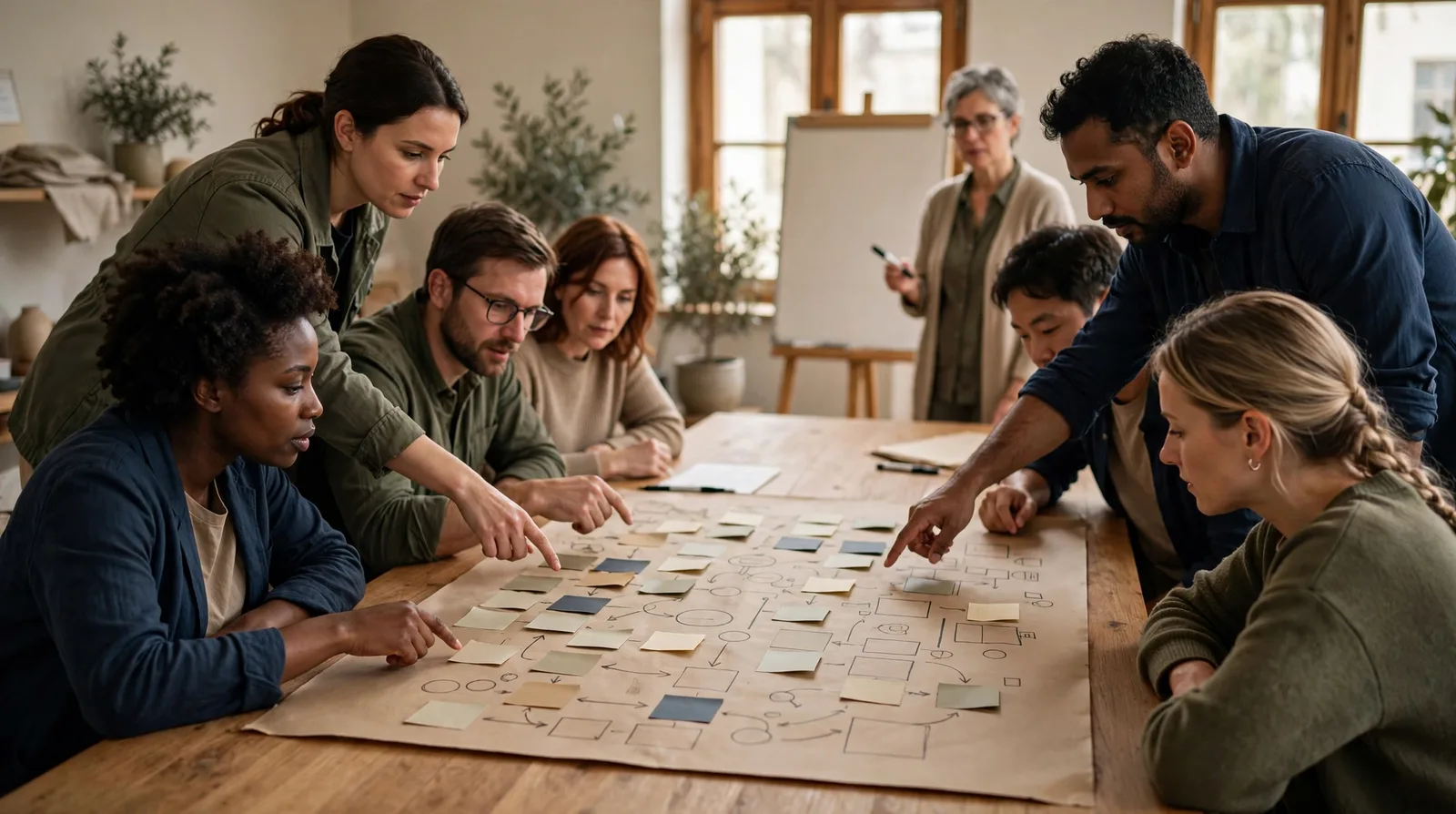
Change is decided in a leadership meeting and made, or not, in the conversations that follow. We facilitate the moments when a reorganization, a merger or a post-acquisition integration depends on people: leadership lands on the same message, teams say what is lost and what is kept, and the new decision rules get written in the room.
Sound familiar?
The reorganization is announced, but teams work as before. The org chart changed. The meetings, the approval chains and the loyalties stayed the same, and everyone waits to see whether the change is really happening.
Two companies under one name, two ways of working. After an acquisition or merger, each side treats its own habits as normal. Nobody explicitly decides what to keep from each, so things get decided by attrition.
Leadership agrees on the slides, yet every director tells their team something different. The message about the change arrives in four versions, and people pick the one that suits them.
The change has started, and people's questions have nowhere to go. They get discussed in the hallway. Leadership hears about them late, when they have already become resistance.
- Duration
- from a one-day session to a multi-stage process, set during diagnosis
- Format
- In person, online or hybrid
- Group
- 6–100 participants; above 60 we work with a team of facilitators
- A good fit when
- you are reorganizing, merging or integrating an acquisition, and the hard part is the people, not the org chart.
What the facilitator does, and what stays with the organization
Facilitation does not replace change management consulting. A consultant designs the change and delivers the plan. A facilitator holds the process through which the organization's own people build it, understand it and own it. The decision stays yours.
Lára Kristín Skúladóttir, a facilitator from Reykjavík, uses the image of the harbour pilot (lóðs in Icelandic): the pilot comes aboard to guide the ship out of a crowded harbour, knows the waters, and never takes responsibility away from the captain. The full story is in our article on the 12 edges of facilitation.
- You need a change plan written by an expert
- Consulting. We tell you so from the diagnosis, so you don't buy facilitation for something else.
- You already have a plan and it stalls at the people level
- Facilitation: alignment, dialogue between parties, decisions people own.
- The managers leading the change need new skills
- Training or The Facilitation Academy.
Where we step in, concretely
- Leadership alignment, before the announcement
- "Are the directors saying the same thing?" We work with the leadership team so the message, the reasons and the open questions belong to everyone before they reach the teams. The methods are the ones on the strategic alignment page.
- Dialogue between the parties that are joining
- "We used to do it differently." We put both ways of working on the table, without making either "the right one", and the group chooses what to keep from each. At the level of a single team, see new or changing team.
- New decision rules
- "Who decides now?" After a reorganization the old approval chains no longer work and the new ones are written nowhere. We clarify, by type of decision, who decides: alone, after consultation, or together.
- Room for people's questions
- "We find out in the hallway." With large groups, we use formats where people propose their own topics and work on them, so the real questions reach leadership in the meeting.
Methodologies we use here
Sociocracy
You decide by consent: a proposal passes if nobody has a reasoned objection. A good fit for decisions that have to hold after a reorganization, because there is no more "I didn't agree, but I stayed quiet."
LEGO® Serious Play®
Build a model, then explain it. The metaphor surfaces tensions between groups that did not choose each other: competing priorities, unspoken assumptions, what the change costs.
Open Space Technology
With large groups, participants propose and choose their own topics. It fits the time right after a change is announced, when people's questions can't be guessed in advance.
ToP® Technology of Participation
For situations that need real consensus, not a list of ideas: the group starts from individual contributions and arrives at a decision it can stand behind.
What the organization receives
Deliverables are agreed before the project. Depending on the objective, they may include a summary of decisions, priorities, owners and deadlines, a working canvas, or recommendations for the next steps. Materials from the session stay with the client.
How we work on this
- Diagnosis. We sign an NDA before the diagnosis, not before the contract. We hold a conversation with the sponsor and a few with people from the parties involved: what was announced, what is said in the hallway, where the change stalls. On sensitive topics we agree from the start on what gets reported to the sponsor.
- Design. You get a proposal with three scope options. The diagnosis picks the method, not the other way round.
- Facilitation. We hold the process. The content and the decisions stay with the organization.
- Follow-up. At 30 days we check what survived the first difficult stretch. The result is measured at the office, not in the room.
What we ask of you: a sponsor with decision authority, available for three conversations (the diagnosis, the design validation, the debrief). Projects most often go wrong when the sponsor delegates completely.
"He is one of those facilitators who don't just deliver content, but create contexts where people learn from each other and build real connections."
Roberta Ioachim, Training Manager, Servier Romania, about Bogdan Grigore (translated from Romanian)
Going further
If the change began with a new strategic decision, see strategic alignment. If you are not sure whether you need facilitation or something else, the ten questions will help you find out. For the brief to a facilitator, corporate workshop facilitator explains what it should contain.
Free tools on this topic
Frequently asked questions
A consultant designs the change and delivers a plan. A facilitator holds the process through which leadership and teams build what comes next together, without bringing the answer and without making the decision for the organization. If you need a plan written by an expert, that is consulting and we tell you so from the diagnosis. If the plan exists and stalls at the people level, facilitation steps in exactly there.
Ideally before, with the leadership team, so the message, the reasons and the open questions are the same for every director. Then after the announcement, with the teams, when the questions leadership did not anticipate appear. If the announcement has already happened, it is still worth it: dialogue can be opened weeks or months later.
Yes. Two organizations arrive with two ways of working, each seen as normal. The sessions put both on the table, without making either one "the right one", and the group decides what to keep from each and who decides what from now on. For the level of a single merged team there is a separate page, New or changing team.
That is to be expected after a change announcement. We choose formats where contribution does not depend on who speaks loudest, and we dose exposure: nobody is asked to open up before it feels safe. On sensitive topics we agree from the start on what gets reported to the sponsor and what stays in the group.
We set the duration during diagnosis, from a one-day session to a multi-stage process. The price has four components: process design, facilitation days, the number of facilitators in the room, and materials. We do not charge per participant. After the diagnosis you receive a proposal with three scope options.
Deliverables are agreed before the project. Depending on the objective, they may include a summary of decisions, priorities, owners and deadlines, a working canvas, or recommendations for the next steps. Materials from the session stay with the client, and at 30 days we review together what held.
A sponsor with decision authority, available for three conversations: the diagnosis, the design validation and the debrief. Projects most often go wrong when the sponsor delegates completely.
Yes. We work in Romanian and English, in person, online or hybrid. Above 60 participants we work with a team of facilitators, and above 150 we run a technical rehearsal the day before.
A reorganization, merger or transformation under way?
A free, 30-minute diagnosis tells us both whether it is a problem facilitation can solve.
Let's talk about your change