
Conference moderation and large-event facilitation
Two people can stand in front of the same room of 50 and do completely different jobs. One manages time and the floor. The other designs the day so the room produces a result. In Romania both are requested with the same word: “moderator”. This page explains the difference, so you know what you are asking for and what you are comparing the quotes against.
What people are actually asking for when they ask for a moderator
Judging by the requests that reach me, they split in two, and the people sending them use the same word for both.
- Stage moderation
- You introduce the speakers, keep the rhythm, run the panel, collect questions from the floor, close on time. The agenda comes from the organiser. Quality shows in presence, in pacing, and in the ability to get something interesting out of a guarded guest. A good journalist or an experienced host does this very well.
- Event facilitation
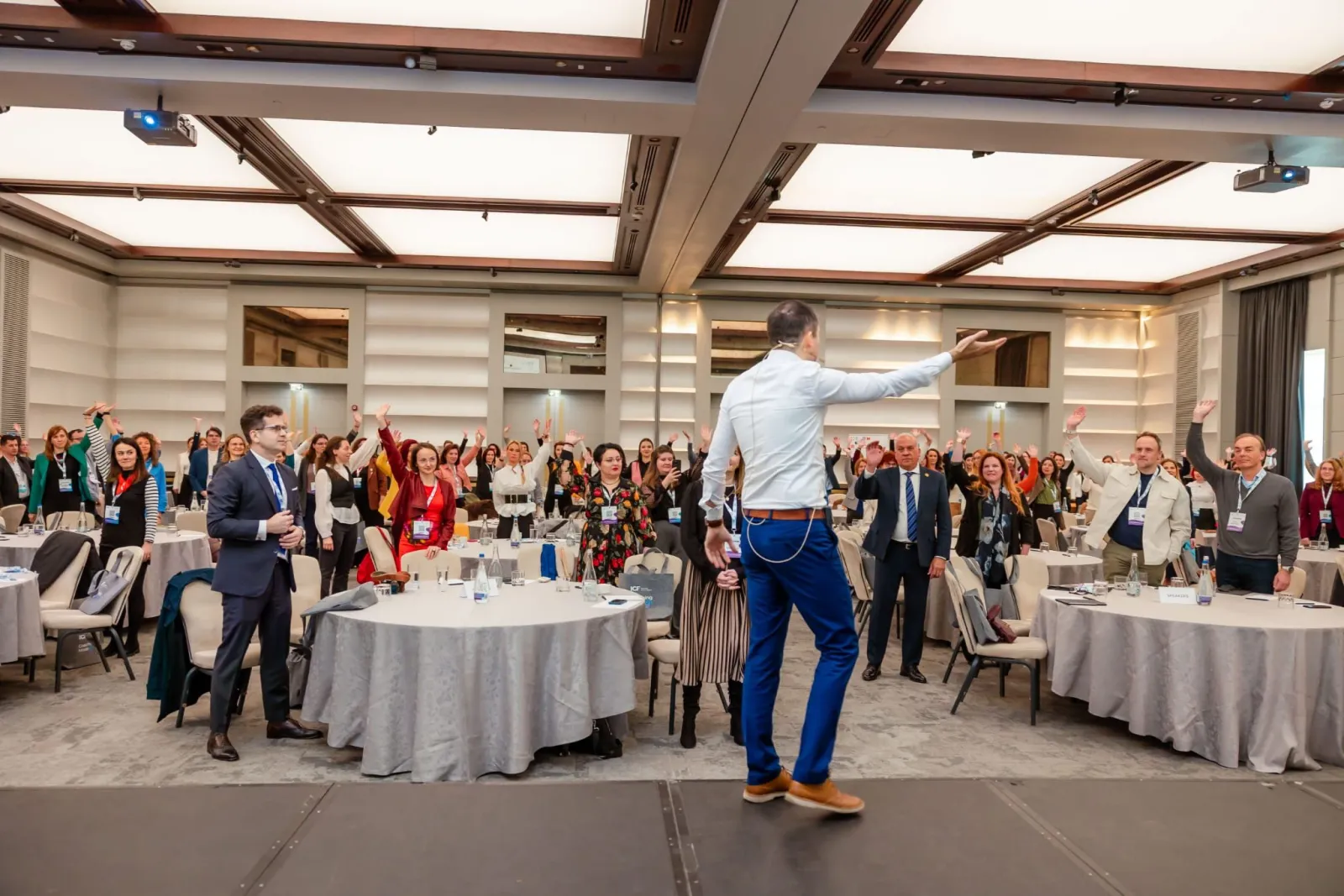
- You build the agenda together with the organiser, starting from what has to exist at the end. You choose the formats through which the people in the room work, not just the people on stage. You hold the process for eight hours, including the stretches where the group gets stuck. And you produce a written synthesis of what the room came up with. Quality shows the next day, in what is left.
Confusing the two costs money in both directions. Paying a facilitator to announce speakers is overpaying. Booking a host for an eight-hour workshop where 50 people have to reach a shared position buys you a pleasant day and no result, after which everyone assumes the topic was the problem.
The question that settles it in ten seconds
What has to exist at the end of the event that did not exist at the start?
If the answer is “people learned things”, “we celebrated”, “we launched the product” or “it was a successful gala”, you need a good moderator, and this page has mostly saved you from overpaying.
If the answer is a decision, a list of priorities, a shared position of the association, an action plan with owners and deadlines, or simply “these people need to hear each other, not just listen to someone”, then what you are looking for is facilitation, even if the brief says “moderator”.
The formats I work in
- Conference with panels and working sessions
- I moderate the stage and design the moments where the room works, so the audience is not sitting still for six hours. Short working sessions between panels change the energy of a one-day conference completely.
- Full-day workshop with a large group
- 30 to 150 participants, agenda built together, small-group work with convergence in plenary, synthesis at the end. The format most often requested by professional associations and by organisations consulting their members.
- General assembly and member consultation
- When the people in the room come from different positions and the subject is sensitive, structure decides whether you get a useful discussion or an exchange of grievances. It is designed in advance, not improvised at the microphone.
- Strategy session and management retreat
- Small group, high stakes, two or three days. Details at TeamRetreat.ro.
- Hybrid event
- People in the room and people on screen, with formats that give the remote participants an equal vote. Without that, the online audience turns into television viewers within the first 20 minutes.
How we work
- The purpose conversation. Thirty minutes, free. We establish what has to exist at the end and whether you need moderation or facilitation. If you need stage moderation, I tell you so and recommend someone suitable.
- Preparation. Two or three short conversations with people inside the organisation, so the agenda sits on your reality. This is what separates an agenda that looks good on paper from one that holds for eight hours.
- The design. The architecture of the day: which format at which moment, how long each one runs, where the group is likely to get stuck and what I do then. You get it in writing before the event.
- The day itself. Facilitation throughout, with additional facilitators on working groups if the group is large. I take the photographs.
- The synthesis. The closing document, in the format agreed in advance: internal note, association report, or material for public communication.
Why the network matters at large events
Above roughly 40 participants, one person at the front can no longer keep the group working. They can only keep it attentive, which is a different thing. From there upwards I work with facilitators from the Facilitare.ro network, one per group, with a shared design and a shared debrief at the end. See who they are.
That is the practical difference between 150 people listening to a panel and 150 people producing something in the same day. A speakers' bureau sends you one person for the stage. The second scenario needs a team carrying the same design in their heads.
What it costs
There is no list price, and I have no way of inventing one without knowing what you are asking for. What I can say publicly: projects so far have ranged between 1,000 and 7,000 EUR. Five things move the price within that range:
- The number of sessions
- The complexity of the topic and the design
- The amount of preparation beforehand: interviews, diagnosis, tailored materials
- The number of facilitators in the room
- The number of participants
My company is not VAT-registered, so the price you get is the final price. Nothing is added on top. For an association, a professional body or any organisation that cannot reclaim VAT, that means a quote from me and a quote with the same figure from a VAT-registered supplier are not the same cost: the second one costs more, with the standard rate added. Worth checking when you compare quotes.
A two-hour intervention on an agenda that is already set sits at the bottom of the range. A full day with a large group, preparation interviews and a synthesis document at the end sits at the top. If you are putting a budget together and need a figure before the details are settled, say so directly and I will send you an order of magnitude the same day.
Frequently asked questions
A moderator manages time and the floor: introduces the speakers, keeps the rhythm, collects questions from the audience. The agenda is handed to them. A facilitator designs what happens in the room so that a result comes out of it: builds the agenda together with the organiser, chooses the formats through which the 50 or 150 people in the audience do the work, and produces a written synthesis of what was decided. Both roles are legitimate. The choice depends on one thing only: whether the audience is there to listen or to produce something.
The test question: what has to exist at the end of the event that did not exist at the start? If the answer is “people learned things” or “it was a successful gala”, you need a good moderator. If the answer is a decision, a list of priorities, a shared position of the organisation, or a plan the people in the room will still back once they go home, you need facilitation. A moderator handed the agenda the day before cannot deliver the second answer, however good they are on stage.
There is no list price; every project is quoted individually. Projects so far have ranged between 1,000 and 7,000 EUR. Five things move the price within that range: the number of sessions, the complexity of the topic and the design, the amount of preparation beforehand, the number of facilitators in the room, and the number of participants. A full day with a large group, an agenda built together and a synthesis document at the end sits at the top of the range. A two-hour intervention on an agenda that is already set sits at the bottom.
Above roughly 40 participants, one person at the front can no longer keep the group working; they can only keep it attentive. From there upwards I work with facilitators from the Facilitare.ro network, one per working group, with a shared design and a shared debrief. That is the difference between 150 people listening to a panel and 150 people producing something in the same day.
A synthesis of what the room produced: the themes that kept coming back, the points where the group agreed, the points where it did not, and the next steps with owners and deadlines if the event got that far. The format is agreed in advance, because an internal note, an association report and a public statement are three different things. Photographs during the event are taken by me and come at no extra cost.
Yes, in Romanian and English, including mixed groups and hybrid events with remote participants.
Have an event and not sure what to ask for?
Thirty minutes of conversation, free, tells us both whether you need stage moderation or facilitation. If it is the first, I will recommend someone suitable and save you an expense.
Let's talk about your event