
Emotional culture
Organizations declare a mission, values, and goals. People live, day to day, appreciation or frustration, trust or insecurity, energy or exhaustion. That experience is the real emotional culture, no matter what's written on the wall. We facilitate the conversations that make it visible and turn it into concrete behaviors.
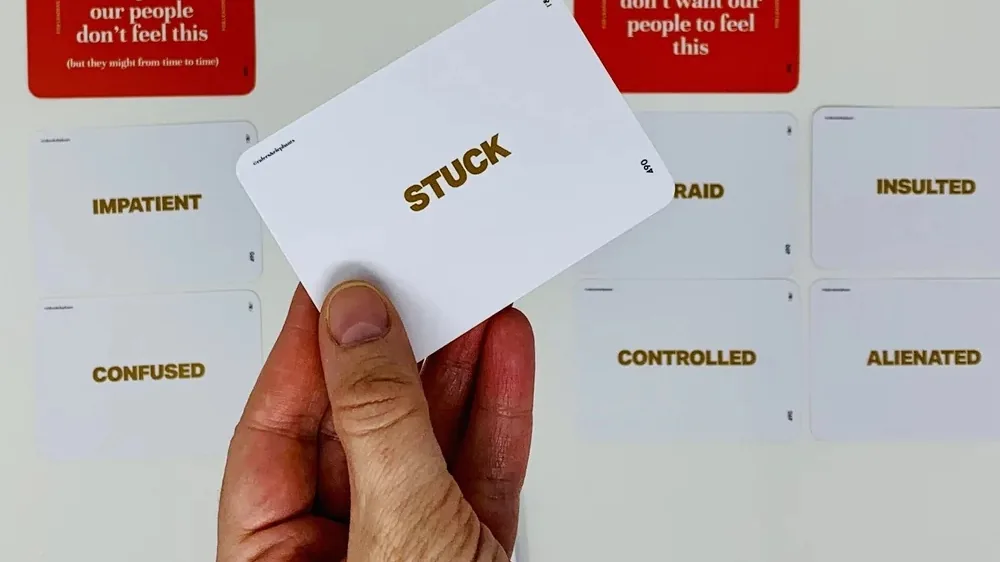
Values are on the wall. Emotions are at the table.
Most organizations work hard on their cognitive culture: what we do, what we believe, what we set out to achieve. Almost none work consciously on their emotional culture, even though it forms anyway, in every meeting and every exchange of messages.
The result is a gap everyone feels and no one names: the wall says "collaboration," while in the room people stay quiet so they don't seem difficult. It isn't hypocrisy, it's just a culture left to form on its own.
What we do
Cognitive culture
- Tasks and goals
- Processes and procedures
- Structures and roles
How we feel
Emotional culture
- Positive and negative emotions
- Personal experiences
- Relationships and connection
These are two layers of the same culture, and performance needs both. The difference is that the first layer is written down, measured, and discussed in meetings, and the second is lived in silence.
From emotion to performance
Emotions aren't the "soft part" of an organization. They're the start of an observable chain, in which each link produces the next one.
- EmotionsWhat people feel, day to day, at work.
- BehaviorsEmotions, sustained, become repeated actions.
- CultureRepeated actions become team norms.
- PerformanceSatisfaction, retention, and better results.
The chain runs both ways. A team where people constantly feel judged doesn't arrive at "lack of initiative" through a decision, but through repetition: silence becomes behavior, behavior becomes norm, norm becomes culture.
What the research shows
The concept of emotional culture was formulated by Sigal Barsade (Wharton) and Olivia O'Neill (George Mason), who explicitly distinguished it from cognitive culture in Manage Your Emotional Culture (Harvard Business Review, January 2016) and studied it in the field in a longitudinal study published in Administrative Science Quarterly (2014).
Their central finding: a workplace's emotional culture predicts outcomes every organization already tracks, and the effects show up both in employees and in the customers they serve.
- PerformanceEmotions shape attention, creativity, and the quality of decisions, exactly the resources day-to-day work is made of.
- Retention and absenteeismIn the field study, units with a warmer emotional culture had lower absenteeism, a marker that usually moves together with intent to leave.
- EngagementEngagement doesn't come from a values statement, it comes from the repeated experience of people who are cared for. It's built from many small actions.
- CollaborationTeams with a healthy emotional culture report better teamwork: people ask for help earlier and pick up each other's work more easily.
- CommunicationWhen emotions share a common name, hard conversations become possible without accusations. Without vocabulary, the same conversations get postponed.
- Customer experienceThe state people work in transfers into the customer interaction. In the 2014 study, the effects showed up in customer satisfaction and mood too, not just employees'.
- BurnoutBurnout is tied to emotional culture, not just workload. Cultures dominated by fear or anger exhaust people faster than overtime does.
- ConflictA shared emotional vocabulary shifts conflict from people to needs: instead of "you're being defensive," the team can name what's making someone feel unsafe.
The methodology we use in the room builds on this conceptual framework, and is used today in over 70 countries, in over 1,500 organizations.
Every team has its own microculture
Under the same roof, with the same handbook of values, two teams can have completely different atmospheres. That's the good news: emotional culture doesn't need to change company-wide for something real to change.
- It forms anyway. There's no team without an emotional culture, only teams that haven't named theirs.
- It becomes visible once we name it. The first win of a session is people discovering they weren't the only ones feeling that way.
- It changes through behaviors and rituals. Not through posters, and not through a leadership announcement.
How the methodology works
We work with a methodology built on emotion cards and guided questions. The format is intentionally simple: the goal is for people to talk about things that are hard to say, not to learn a model.
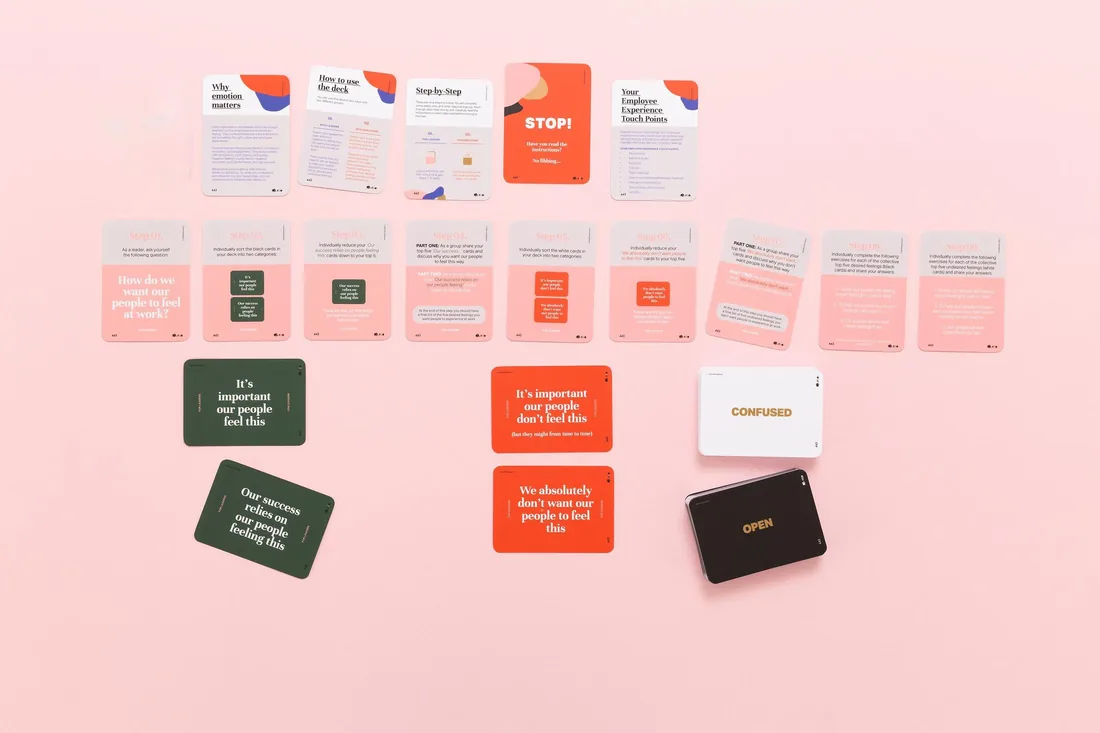
The cards help people clarify three things: what they need to feel to succeed, what they don't want to feel, and what concrete behaviors can support the change.
A shared vocabulary for things that are hard to say
The most common blocker isn't ill will, it's the lack of words. "Something's off with this team" isn't a problem you can solve. "We feel controlled and we don't feel heard" is.
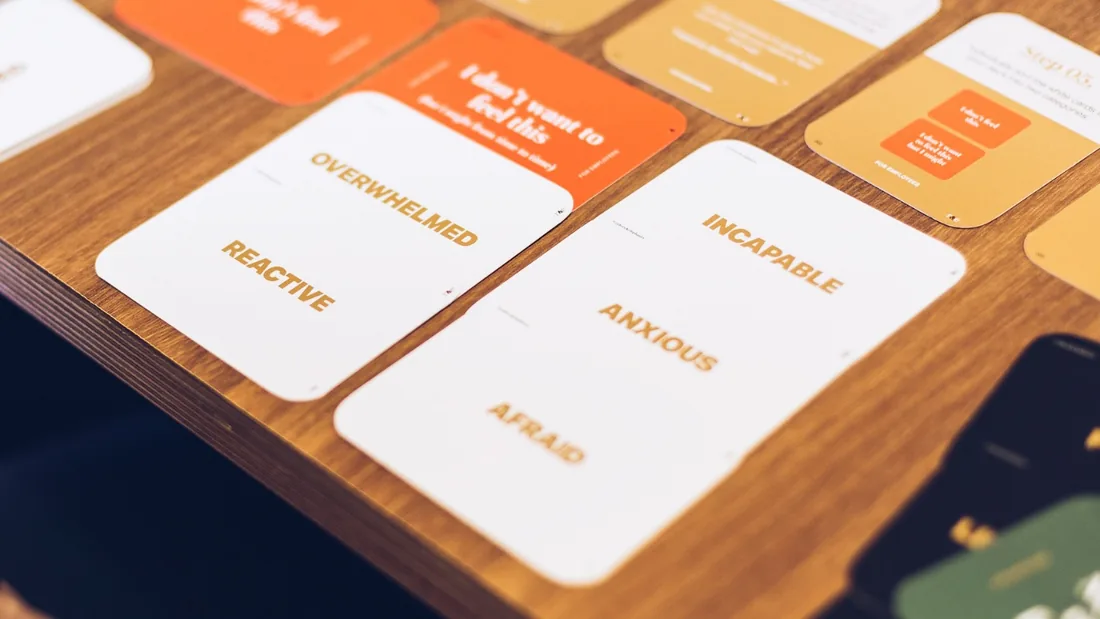
This is not an emotional intelligence course
Participants don't receive a list of "correct" emotions and no model to memorize. They build the answer to three questions together:
- What do we need to feel to succeed?
- What do we not want to feel?
- What can each of us do, for the culture we want?
The difference shows up in the third question: responsibility shifts from "someone should…" to "what can we do."
The arc of a workshop
- ConnectEmotional retrospective
- UnderstandTop desired and unwanted emotions
- AssessHow present they are today
- ChooseOne focal emotion
- ExperimentTestable rituals and actions
The session doesn't end with a nice conclusion, it ends with something that can be tested in real work, in the following weeks.
What remains after the workshop
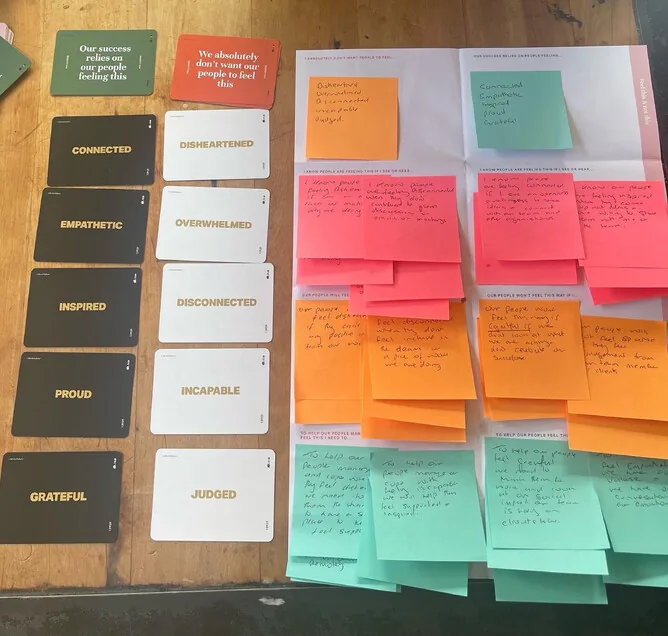
- Shared language
- People can talk more clearly about their work experience, without accusing anyone.
- Gap map
- What's worth keeping, growing, or reducing, comparing what the team wants to feel with what it feels today.
- Clear focus
- One priority emotion for the period ahead, instead of a list nobody follows up on.
- Testable rituals
- Small, repeatable actions, reviewed after 2-4 weeks.
The four workshops
Same methodology, four entry points. The choice starts from your context, not from a standard product, and gets made at the diagnosis before the session.
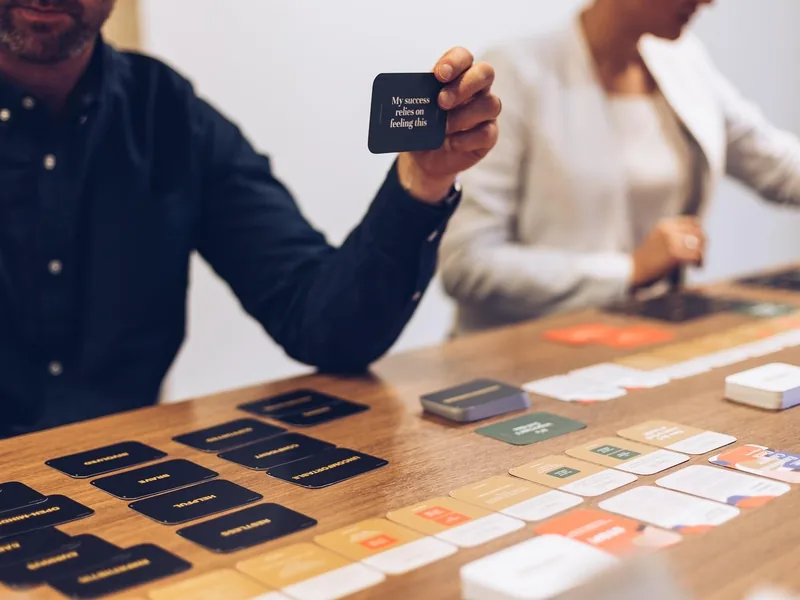
Emotional culture for teams
The team identifies the emotions it needs for success and the ones draining its energy, then turns the conclusions into behaviors and team rituals. For teams that feel "something's off" but can't name what.
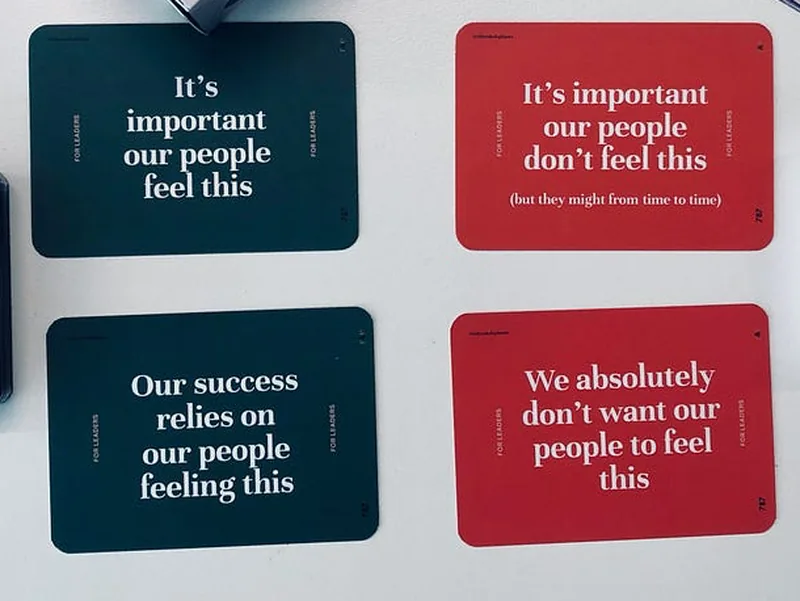
Emotional culture for leaders
Leaders explore what they want their people to feel and how their own behaviors support or block that experience. Applied directly in 1-on-1s and difficult conversations: intention, behavior, impact.
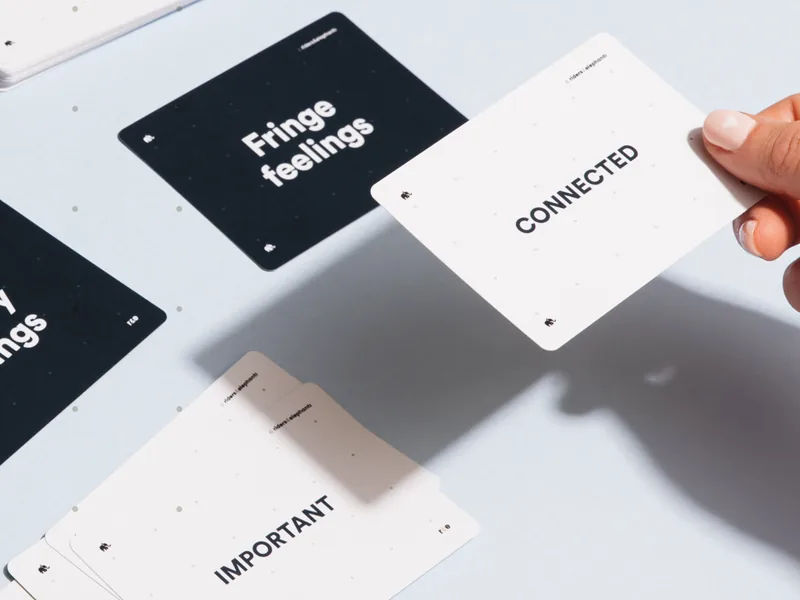
Customer experience
The team looks at the experience through the customer's eyes and connects the desired emotions with the moments that create them: what we want them to feel, what we don't, what we do concretely at every touchpoint.
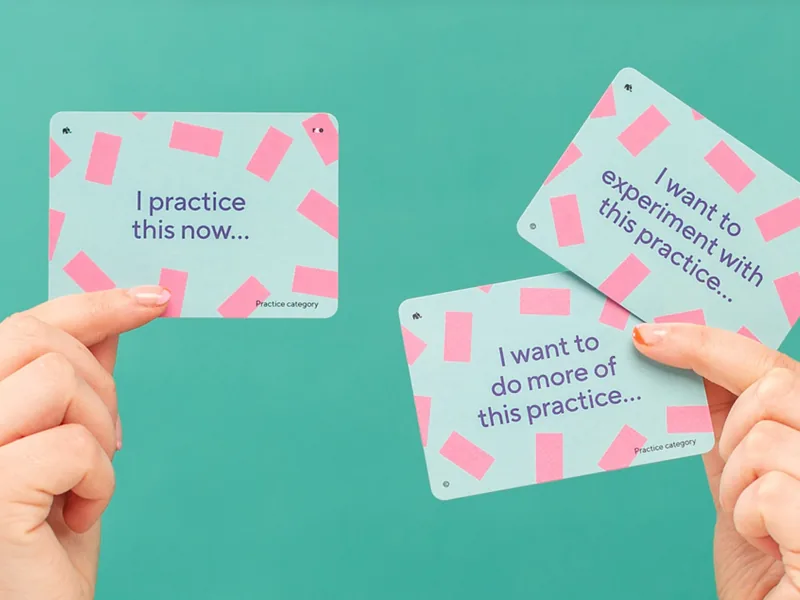
Wellbeing
An individual format run in a group. Each participant clarifies their emotional needs and builds a personal wellbeing plan, applicable at home and at work. A good first contact with the methodology, with participants from different parts of the organization.
How we work together
- Conversation. We understand the context and the goal. The first conversation is free.
- Quick diagnosis. We choose the right format, or tell you if your topic needs something else.
- Design and workshop. We adapt the process to the actual group, not deliver an off-the-shelf module.
- Experimentation. The team tests the chosen rituals, in day-to-day work.
- Follow-up. We review after 2-4 weeks what worked and what changes.
The design is a hypothesis. The group is the reality.
Who facilitates
Bogdan Grigore has worked with groups for over 20 years, blending facilitation, psychology, and applied improvisation. He's the founder of Improvizatie.ro, the first applied-improv-for-business company in Romania, and of the IAF Romania community. Emotional culture is one of his core practices for working with teams and leaders.
"People will forget what you said, people will forget what you did, but people will never forget how you made them feel."
Maya Angelou
Frequently asked questions
A course teaches a model and a list of "correct" emotions. Here, participants don't receive answers, they build them: what we need to feel to succeed, what we don't want to feel, what each of us can do about it. The result is a decision the group owns, not a theory each person remembers separately.
The session doesn't ask anyone to share their feelings out loud. We work with cards and structured questions, and the outcome is operational: one priority emotion and two or three rituals to test over the following weeks. Technical teams usually settle into it faster than the manager expects, precisely because the format is concrete.
The team and leadership workshops: 3.5 hours, 10-12 people. Customer experience: 3 hours, 6-15 people. Wellbeing: 2 hours, 10-12 people. For larger groups we build a separate format, with more facilitators.
A shared language for the work experience, a map of the gaps between what the team wants to feel and what it feels today, one priority emotion, and testable rituals, reviewed after 2-4 weeks. The design is a hypothesis; what remains is what survives the test of real work.
That's exactly when it makes the most sense, with a diagnosis first. The cards give a language for things that are hard to say directly, and naming the unwanted emotions explicitly lowers the pressure to look positive. If the diagnosis shows an open conflict between specific people, we suggest a different format first: emotional culture works at the team level, it doesn't replace mediation.
What emotion do you want the change to start with?
A free, 30-minute conversation tells us whether your topic is about the team, leadership, customer experience, or wellbeing, and which format makes sense.
Let's talk about emotional culture