
What is professional facilitation
Professional facilitation means designing and running the process by which a group reaches an outcome (a decision, a plan, a solution) without getting involved in the content of the discussion. The facilitator is neutral about what the group decides and responsible for how it gets there: who speaks, in what order, on what information, and how the topic gets closed. The expertise stays with the people in the room; what was missing was the structure to bring it out. Facilitation steps in when a group has the expertise but can't reach a shared answer.
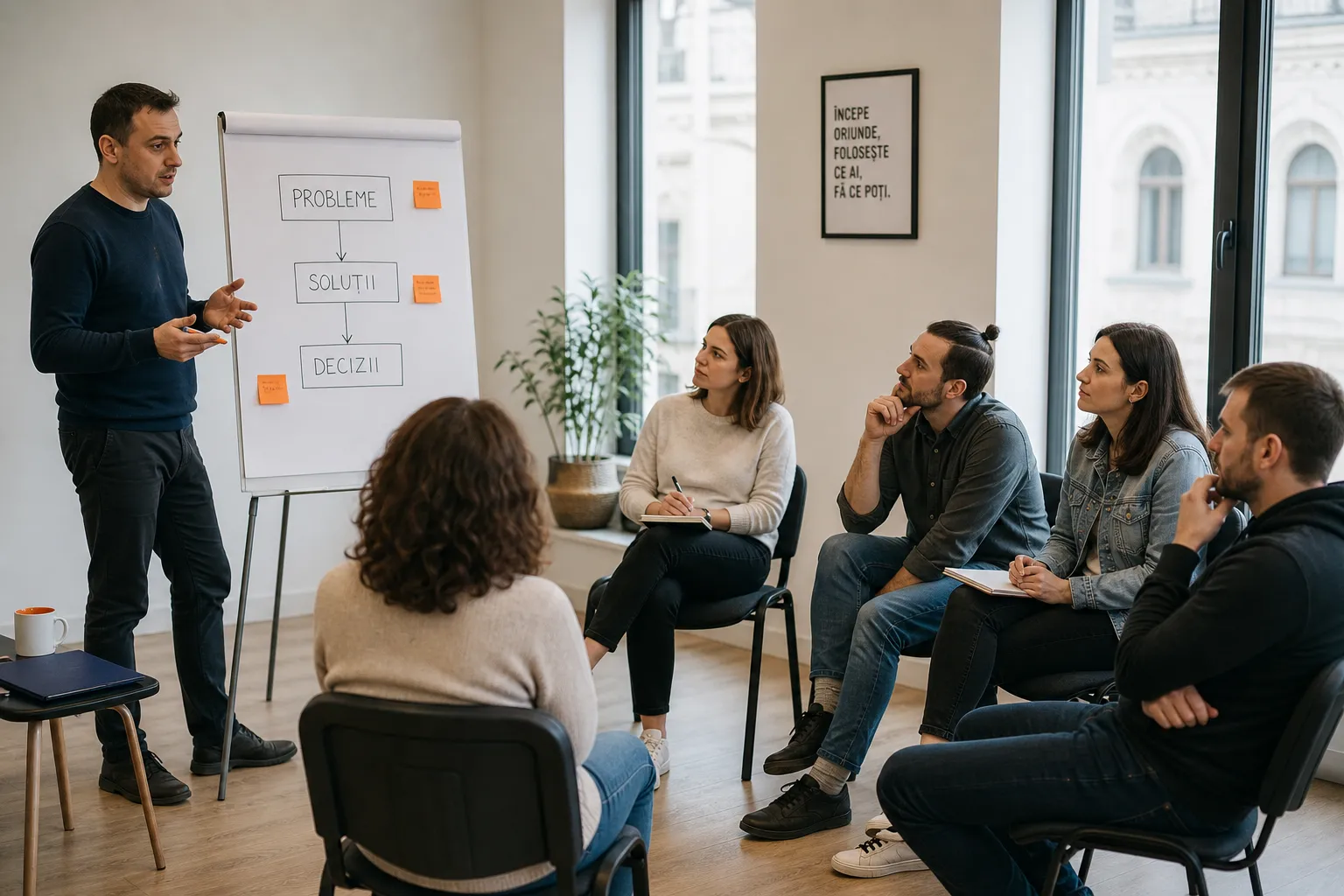
Signs you need facilitation
- Meetings that everyone leaves with a different understanding of what was decided.
- Two departments with plans that contradict each other, and both are right.
- A 200-person townhall where the same 3 people do all the talking.
- The company bought AI licenses; three months later, only the people who'd have used them anyway still do.
- The same tense conversation comes back to the team for the third time, in different words.
- You have values on the wall and behaviors that contradict them in every meeting.
If you checked at least two, the rest of this page shows you where facilitation steps in.
Where facilitation steps in
Alignment, decisions and change. The signal: two departments walk out of the same discussion with contradicting plans, or the company is going through a restructuring and real feedback never reaches leadership. In the room: the process separates idea generation (divergence, no filtering) from choosing one (convergence, with clear criteria), and gives resistance a constructive channel instead of letting it grind on in side conversations. What's left: a decision every side actually carries forward, not just the loudest one. → Strategic alignment · Effective meetings
Culture and psychological safety. The signal: you have values on the wall and behaviors that contradict them in every meeting, or there are "unwritten rules" nobody states out loud but everyone follows out of caution. In the room: values get co-created with the people, not handed down from above, and the tension between department micro-cultures surfaces in a controlled way, not in the hallways. What's left: a level of psychological safety where people can say "I don't know" or "I got this wrong" without risking their job. → Team cohesion
AI adoption as a people problem. The signal: the company bought AI licenses; three months later, only the people who'd have used them anyway still do. In the room: the team redesigns its own workflow with AI built in, instead of sitting through a generic demo, and names the unspoken fear directly: the one that makes people smile in training and quietly avoid the system afterward. What's left: a way of working the team built itself, so it actually sticks; 70% of why AI projects fail is people and process, not technology. → AI Adoption
Large groups: conferences, townhalls, kick-offs. The signal: at a 200-person townhall, the same 3 people do all the talking while everyone else checks their phone. In the room: participation structures at scale (from small parallel discussions to ways of gathering everyone's input in minutes, not hours) turn the audience from spectators into contributors. What's left: hundreds of people who feel part of the decision, not just present for its announcement.
Organizational learning and communities of practice. The signal: classic training is forgotten within two weeks, and the people who actually know something useful have nowhere to pass it on. In the room: communities of practice and learning circles where people take charge of the conversation, plus simulation exercises where mistakes are working material, not embarrassment. What's left: a habit of continuous learning that doesn't depend on the next training budget, including the internal capacity built through the Facilitation Academy.
What a facilitator does
Designs the process (who speaks, in what order, what method gets you to a decision), holds the group's time and energy, surfaces what usually stays unsaid, and makes sure the decision made in the room is one people actually carry forward. A facilitator who "guides" the group straight to their own conclusion has stopped facilitating; they're selling an opinion disguised as a process.
Why the CEO can't facilitate their own meeting
A facilitator is accountable for the process and neutral on the outcome. A CEO, a director, any team leader is accountable for exactly that outcome, so they cannot be neutral about it, however well they run a discussion. The two roles cancel each other out in the same meeting.
What actually happens when a leader tries to hold both:
- People read the preference, not the question. When the person asking "what do you think?" is also the person who signs off on budgets and reviews, silence isn't agreement, it's calculation.
- You can't contribute and referee at once. Hold the process and you forfeit the right to argue your own position; argue it and the process becomes a tool of persuasion.
- Disagreement moves to the corridor. The discussion in the room closes quickly and politely, and the real objections surface afterwards, in conversations you're not part of.
- Decisions get made but not carried. A group that said yes to end the meeting executes exactly the way it decided: without conviction.
None of this means leaders shouldn't run meetings. For ordinary status and coordination work, that is their job. The line is the stakes: the more contested the decision, the more emotionally loaded it is, or the closer it sits to the leader's own interests, the more it matters that someone else holds the process. That someone can be an external facilitator or an internal one from another department, with a single condition: no stake in what gets decided. That's what the Facilitation Academy builds: internal people who can hold the process for teams that aren't their own.
When it's not the answer
Two situations where facilitation won't help, however trendy the word: the decision is already made and you're just looking for a rubber stamp; the team is missing basic technical knowledge: that calls for training first, not a decision process.
Facilitation, or something else?
| If… | Choose | Because |
|---|---|---|
| your people know, but can't reach a shared answer | facilitation | the expertise is in the room; what's missing is the process that gathers it |
| your people don't know how to do something | training | the gap is knowledge, and someone from outside has it |
| the team has a recurring pattern (communication, decisions, conflict) over months | team coaching | it needs ongoing work, not a single session |
| you need someone else's answer, with ownership attached | consulting | you're paying for a recommendation, not a conversation |
The boundaries aren't airtight: most real projects combine more than one.
Frequently asked questions
Not on the topics that matter. A facilitator is neutral on the outcome, while the CEO is accountable for that outcome: the two roles cancel each other out in the same meeting. When the person asking "what do you think?" is also the person who signs off on budgets and reviews, silence isn't agreement. For status and coordination meetings a leader can run them fine; for a contested decision, a conflict between departments or a restructuring, the process needs someone with no stake in the result.
When the topic is too loaded to run the discussion and hold the process at the same time: a contested decision, a conflict between departments, a restructuring. If you're both the authority in the room and the person holding the process, people either censor themselves or wait to hear what you want to hear. A facilitator (external, or internal but neutral on the topic) removes that role conflict and lets you actually take part in the discussion instead of just refereeing it.
In classic training, the focus is on transferring information from an expert to the participants. Facilitation starts from the premise that your team already has the technical expertise it needs, but needs a clear process to reach results. We create the frame, the structure and the psychological safety for your people to collaborate, debate ideas, make owned decisions and solve complex problems together. We don't hand you prefabricated answers; we help you generate the best ones yourselves.
Team coaching works on patterns that repeat over time (how the team communicates, decides, handles conflict) across several months, with regular sessions. Facilitation steps in for a specific goal, in a workshop or a short series: a decision to make, a strategy to align, a plan to build. Many projects combine both: a coaching cycle can include facilitated sessions, and good facilitation leaves behind habits that edge toward coaching.
Not just the decision written on a flipchart, but a precedent: the team experienced that it can reach a shared outcome without waiting for someone above to decide for it. The process structure sticks too: many teams reuse the format on their own (how time was split, how the decision got made) at the next difficult meeting, without a facilitator.
Do you recognize your team in any of these?
Four business situations where facilitation steps in directly; pick the one that sounds like your team: