
Where does facilitation end? A map of the 12 edges
A facilitator helps a group get where the group wants to go, without deciding for it. That is all. The trouble starts when the client buys that and expects something else: an answer from an expert, a course, a mediator, a panel moderator, someone who holds the energy of the room. All of those are real and useful professions. None of them is facilitation, and when the contract confuses them, the client pays.
Lucy Chambers, a British facilitator, spent a year asking practitioners around the world where facilitation ends and something else begins. The result is a conversation series, “Edges of Facilitation”, with twelve guests and twelve edges. This article is their map, with what I see in the rooms I work in.
I am writing it for two kinds of people. For those in HR, L&D and management who have to write a brief and choose a supplier, so they know what they are asking for. And for facilitators wondering whether what they do is called what they think it is called.
The best definition I have heard comes from Icelandic
Icelandic has no word for facilitation. Lára Kristín Skúladóttir, a facilitator from Reykjavík, solved the problem by borrowing a word from navigation: lóðs, the harbour pilot.
The harbour pilot is the person who boards a foreign ship to take it out of a crowded, dangerous port. They know the depths, the currents and the local obstacles. They know nothing about the cargo, they do not command the crew, they do not choose the destination. And, as she puts it, “the maritime pilot does not take charge, he never takes the responsibility from the captain”.
That is the most accurate description of the job I have come across. The facilitator brings real expertise, the navigation kind: how a decision gets made in a group of thirty, how a conflict is brought to the surface without exploding, what a day that actually produces something looks like. Accountability for where the ship ends up stays with the captain.
The definition also settles the objection I hear most often in sales: if you decide nothing, what am I paying you for? For the navigation. Nobody asks the harbour pilot to choose which country to unload the cargo in.
The word the client calls me with tells me what they actually want
In the episode about moderation there is a story that changed how I do diagnosis.
A client calls after a major restructuring and asks for “a facilitator or a moderator”. Asked what the difference is, they admit they do not know, but lean towards moderator. The reason surfaces later: they were afraid of the emotions that were inevitably going to come up in the session, and wanted someone who would “put a lid on it”.
Etymology confirms the instinct. Moderator comes from a root meaning to control, to govern. Facilitator comes from making things easy. Those are two different orders, and the client places the right one even when they do not know what the words mean.
Since then, my first diagnostic question is no longer “what do you want to achieve”. It is “what would you rather did not happen in that room”. The answer tells me which job I have.
It happens often that what the manager asks for and what the people describe are two different things. Not because the manager is hiding anything. Usually that really is what they see from where they stand.
The pattern that comes back most often looks like this. The request arrives as a communication workshop, cleanly framed as a skills gap: our people do not know how to communicate, teach them. Then I talk to them and find they express themselves very well. Each of them explains clearly what is not working. It is just that between two teams there is an old, unresolved thing nobody says out loud in meetings, and around which everybody picks their words.
If I deliver what was ordered, I teach active listening techniques on top of something that is not a technique problem. People leave with a good model and come back on Monday to the same conversation they have been avoiding for a year.
What I change is the contract, not the agenda of the day. I go back to the sponsor and say what I heard, without names, and ask whether we are willing to work with the real subject. Sometimes the answer is yes and the day looks completely different. Sometimes it is no, and then at least we both know what we are buying and what stays on the table. And there is a third situation, where the sponsor is himself part of the conflict. There it is no longer my job to lead the discussion, however well I might know how to.
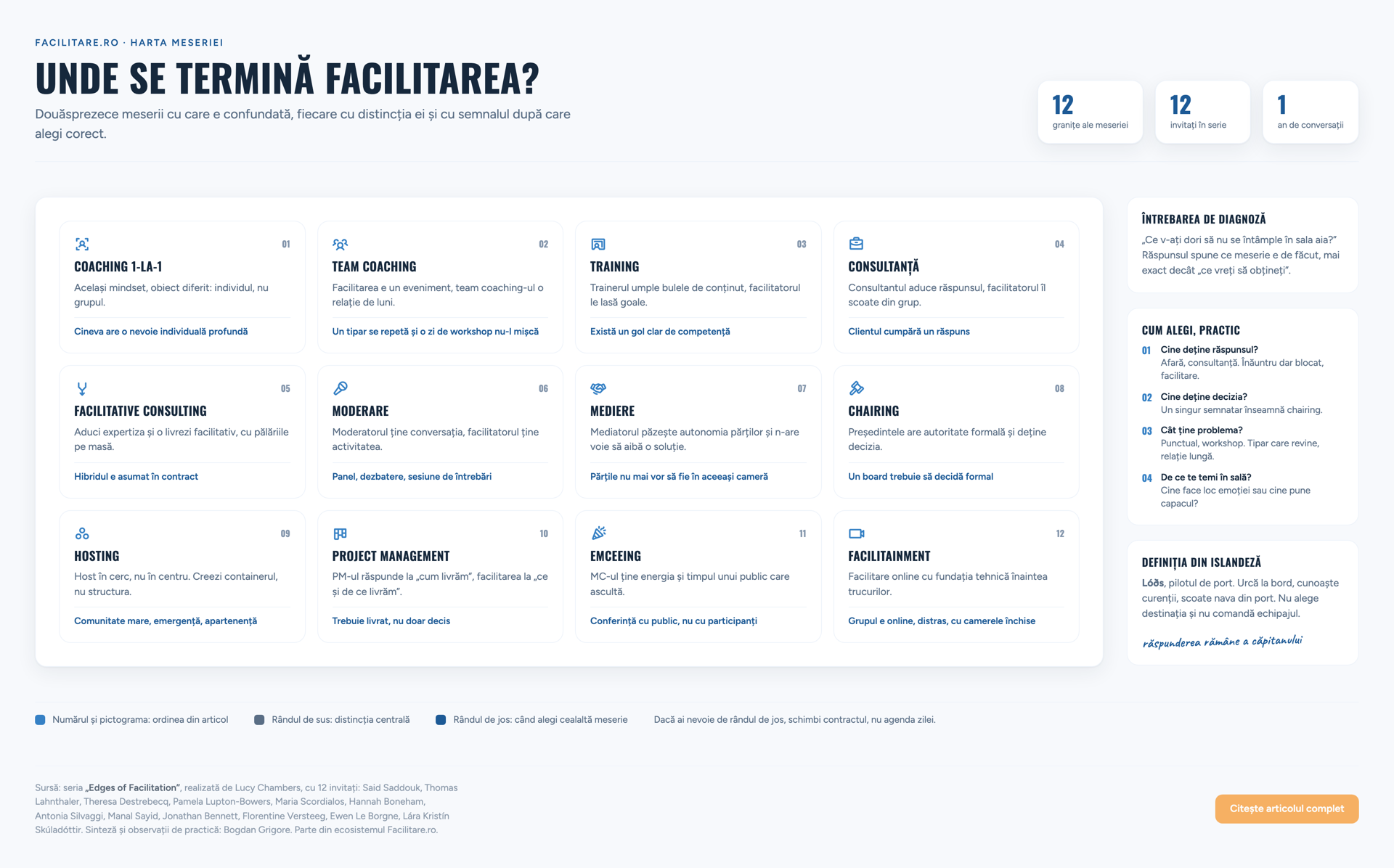
The table of the 12 edges
Read it across. If you need the right-hand column, you change the contract, not the agenda.
| Facilitation vs. | The core distinction | You buy the other thing when |
|---|---|---|
| 1-to-1 coaching | Same mindset, different object: the individual, not the group | Someone has a deep individual need |
| Team coaching | Facilitation is an event, team coaching a relationship of months | A pattern repeats and one workshop day does not move it |
| Training | The trainer fills the bubbles with content | There is a clear skills gap |
| Consulting | The consultant brings the answer, the facilitator draws it out of the group | The client is buying an answer |
| Facilitative consulting | You bring the expertise and deliver it facilitatively | The hybrid is declared in the contract |
| Moderation | The moderator holds the conversation, the facilitator holds the activity | Panel, debate, Q&A session |
| Mediation | The mediator guards the parties' autonomy and may not hold a solution | The conflict is high-stakes and the parties do not want to be together |
| Chairing | The chair has formal authority and owns the decision | A board has to decide formally |
| Hosting | Host in the circle, not in the centre. You create the container | Large community, emergence, belonging |
| Project management | “How we deliver” vs. “what and why we deliver” | It has to be delivered, not just decided |
| Emceeing | The MC holds the energy and the time of an audience | A conference with an audience that listens |
| Facilitainment | An extension of online facilitation: the technical foundation before the tricks | The group is online, distracted, cameras off |
What is the difference between facilitation and coaching?
Coaching works with one person, facilitation works with a group. The mindset is the same: the person in front of you has the resources to find their own answer.
Theresa Destrebecq gives the clearest image of the difference. She tells her coaching client that he is walking through a dense forest trying to find the path. Her role is not to guide him, but to shine light around the corners so he can see where he might go. The fallen branches blocking his way remain his responsibility.
The facilitator shines a light too, but also moves a few of the branches aside so the group can see the path more clearly. That is why facilitation produces a result in hours or days, while coaching needs six to twelve sessions.
The practical difference for whoever is buying: the coaching contract is confidential, the facilitation contract is collectively transparent. Everyone in the room sees the same things.
What is the difference between facilitation and team coaching?
Facilitation is an event with a fixed duration. Team coaching is a relationship that lasts months and works with the team as a system.
Pamela Lupton-Bowers explains the distinction through what you are tracking. In facilitation, your aim is to take the group through a process towards an expected outcome. In team coaching, you also improve the team's capability while it goes through that process: you have them reflect on how they are making the decision, and that counts as much as the decision itself.
The second difference is the direction of the gaze. Team coaching also looks at the team from the outside in: who we serve, what value we add beyond ourselves, what suppliers, competitors and the community expect from us.
The sign that you need team coaching rather than a workshop: the same pattern reappears after every intervention. You have run three good sessions, each ended with a plan, and three weeks later the team is exactly where it was.
What is the difference between facilitation and training?
The trainer has content to transfer. The facilitator has a process through which the group generates the content.
Florentine Versteeg has used a drawing of bubbles for ten years to explain this. The trainer arrives with the bubbles full: they know what has to go in them, and their job is that people leave with them. The facilitator leaves the bubbles deliberately empty, because the raw material is already in the room.
That is why I say workshop, not training, for almost everything I deliver. The word describes what happens in the room: people build from what they know, instead of receiving what I know.
The hybrid has a name too, facilitative training, and it is legitimate. A good course has moments where the expert speaks and moments where they go quiet and put the group to work. What does not work is mixing them without saying which is which, because then the group no longer knows whether its answer counts or whether it is waiting for the correct one.
None of us own any of these words.
What is the difference between facilitation and consulting?
The consultant is paid for an answer. The facilitator is paid for the process through which the group finds its answer.
Lára Kristín Skúladóttir explains it through dance. If the client's problem is that they do not know how to dance, the consultant behaves like a choreographer: listens to the need, leaves, builds the routine, comes back, teaches it and teaches the expertise to perform it. The facilitator behaves like a dance instructor: makes the space, teaches the steps and lets the group find its own rhythm.
The commercial consequence matters more than the metaphor. The consultant's solution can be correct and still fail at implementation, because nobody in the organisation took part in building it. The solution that comes out of a facilitated process is sometimes less elegant and does get implemented, because it is theirs.
When you need a consultant: when the expertise genuinely does not exist in house. Tax, legal, a technology nobody knows. When you need a facilitator: when the expertise exists in house, but is stuck, scattered or unheard.
What is facilitative consulting?
It is the openly declared hybrid: you bring domain expertise, but deliver it through a facilitated process, and the diagnosis is built together with the client.
Lára describes finding the term online and recognising in it what she was already doing. The classic consultant analyses, proposes, builds the change plan and helps implement it. The facilitative version keeps the expertise but moves ownership of the conclusion to the client.
The condition that makes the hybrid work: the hats stay on the table. You say explicitly, in the contract and in the room, when you are speaking as an expert and when you are holding the process. “Now I am giving you my opinion from the experience of twenty other companies” and “now I am asking what you think” are two different moments, and the group has a right to know which one it is in.
What is the difference between facilitation and moderation?
The moderator holds a conversation. The facilitator holds an activity. It is the most quoted of the twelve distinctions, and it is worth saying that not everyone accepts it that cleanly.
When Lucy Chambers put that formulation to Ewen Le Borgne, he did not swallow it. He answered that it is mixed, because facilitators deal with conversations too. They landed somewhere in the middle: moderators, those, really do not deal much with activities. So the distinction holds in one direction, not in both.
The difference shows better in the room than in the definition. At a moderated panel, four people talk and eighty listen. At a facilitated workshop, the eighty work. Good moderation is nearly invisible: it keeps time, balances the voices, asks short questions.
The most useful test for a moderator: if your question takes longer than twenty seconds, you have given a speech with a question mark at the end. And the risk grows with expertise. Whoever knows the subject too well becomes the panel's second speaker.
The other difference is what you do with emotion. The moderator keeps it under control so the discussion can move on. The facilitator makes room for it, because that is often where the information is. This is also the root of the lid story above.
If you are at the point of choosing between the two for an event, the difference is laid out in full here, price ranges included.
What is the difference between facilitation and mediation?
Mediation works with people who no longer want to be in the same room. Facilitation works with people who want to be together and need a process in order to manage it.
Thomas Lahnthaler puts the relationship simply: every mediation is a form of facilitation, but not every facilitation is mediation. The mediator is the guardian of the parties' autonomy. They do not decide, do not suggest solutions, and make sure the agreement is voluntary and that nobody can be forced to stay at the table.
He also says the most uncomfortable thing in the whole series: “almost everything we do as facilitators is a projection of our own need onto the group”. The exercise you choose, the pace you impose, the moment you intervene. Once you see it, it does not mean you stop doing what you were going to do, only that you know why.
The warning sign for whoever is buying: if a manager “facilitates” a conflict they are part of, they do harm, not good. There is no way for them to be neutral on content, and the people in the room know it.
I check this on myself fairly often. I prepare my design in advance, in detail, and that is exactly why it is easy to cling to it.
In one session I had planning scheduled right after lunch. I walked into the room and the energy was low, in the way it is low after a meal, when people are polite and absent at the same time. If I had started the planning as designed, I would have got a list of actions written by three people and nodded through by the rest. I changed the activity and ran an energiser that had a zone of spontaneity in it. In the debrief something came out that I had not planned: exactly what had happened in the exercise, the way people built on each other's ideas without cutting them down, became the material I walked into the planning with.
The rule I hold: the design can change as long as the change takes us towards the same objective. Otherwise it is just my improvisation, on their time.
What is the difference between facilitation and chairing?
The chair of a meeting has formal authority and is accountable for the decision. The facilitator has process authority and is neutral on content.
Jonathan Bennett gives the metaphor, Manal Sayid completes it. Chairing is like driving a bus: you keep the vehicle on route, make sure everyone gets the microphone and that you do not end up over a cliff. Facilitation, says Manal, is more like “choosing the route with the passengers, sometimes getting off the bus to walk alongside folks who aren't ready to ride yet”.
A board needs both, at different moments. A chair who facilitates too much loses the decision. A facilitator who chairs loses neutrality, and once lost it does not come back in the same session.
What is the difference between facilitation and hosting?
Facilitation structures a group towards an outcome. Hosting creates the conditions in which a group organises itself.
Maria Scordialos, from the Art of Hosting tradition, describes the mechanism: “you invite people basically to share their knowledge. When you do that, people immediately start owning the space.” And the reason it matters is practical, not philosophical: when people own the space, implementation afterwards is far easier.
The difference in position is literal. The facilitator often stands at the front of the room. The host sits in the circle, alongside. And harvests: harvesting means gathering the wisdom produced, not taking minutes.
Hosting scales better to large communities and to situations where you do not know in advance what has to come out.
What is the difference between facilitation and project management?
Project management answers “how we deliver”. Facilitation answers “what and why we deliver”.
Antonia Silvaggi, who came into the profession through project management in the cultural sector, describes the edge from the inside. The PM is the guardian of the plan: budget, time, scope. The facilitator is the guardian of the process through which people come to want the same thing.
The two break each other when missing. A project run by the plan alone delivers on time something nobody wanted. A facilitated process without delivery discipline produces enthusiasm and a list of actions nobody takes.
The most useful moment for the two to meet is the kick-off: the PM presents the structure, the facilitator aligns expectations and surfaces the fears that otherwise show up in month three.
What is the difference between facilitation and emceeing?
The MC holds the energy and the rhythm of an event for an audience. The facilitator holds the meaning and the process for a group that works.
Hannah Boneham describes the MC role as the one who starts the party: you lift the energy, make sure everything flows coherently, make sure the audience understands how the pieces of the event connect. You work with a script and with transitions, and time is law.
What is worth stealing from them: the voice, stage presence, transitions designed as part of the experience, and ruthless time management. Facilitators who learn emceeing speak more briefly.
The question to ask the client who invites you to a conference: do you want me to hold the energy of the room, or to get something out of the room? Those are two different offers, at two different prices. What facilitation actually brings to a conference.
What is facilitainment?
It is online facilitation done so that people want to watch, not merely endure. The term belongs to Said Saddouk and combines facilitation with entertainment.
His thesis: if the process is boring, people disconnect, and the result comes out mediocre. And the fix does not start with new tools, but with the foundation. Good audio before video, because a blurry slide is forgiven and bad sound is not. Lighting. Camera placement. Only then the micro-interactions: a poll shown on screen, the chat projected next to you, a second monitor so you are not hunting for a window for thirty seconds while thirty people watch.
One clarification, because it circulates wrongly: Said explicitly says he does not endorse the idea that good audio makes you sound more intelligent. He only says there are studies showing audio matters more than video, without citing figures.
Over all of it sits a rule of professional hygiene he puts briefly: “show up as if you were paid to do this”. And for anyone frightened by the cost, his closing advice is “start small, just be 1% better than whatever you did yesterday”.
How to choose, in practice
If you want the answer without reading the whole thing: the “What kind of facilitation do you need?” test asks ten questions about what is happening in your organisation and tells you what kind of facilitation solves your problem, what kind of facilitator it takes, plus what to write in the brief. It takes two minutes.
Four questions, in this order:
- Who owns the answer? If it is outside the organisation, you need consulting. If it is inside but stuck, you need facilitation.
- Who owns the decision? If one person signs at the end, you need a chair who leads, with facilitative support. If the decision has to be collectively owned in order to be implemented, you need facilitation.
- How long has the problem been running? If it is a single decision or a specific blockage, a workshop solves it. If it is a pattern that keeps coming back, you need a long-term relationship.
- What are you afraid will happen in the room? If the answer is “emotions will come out”, check whether you want someone who makes room for them or someone who puts the lid on. Both are legitimate orders. They just have different names.
Sources
The “Edges of Facilitation” series, created by Lucy Chambers, with guests: Said Saddouk, Thomas Lahnthaler, Theresa Destrebecq, Pamela Lupton-Bowers, Maria Scordialos, Hannah Boneham, Antonia Silvaggi, Manal Sayid and Jonathan Bennett, Florentine Versteeg, Ewen Le Borgne, Lára Kristín Skúladóttir. Quotation marks indicate words said verbatim. The rest is my own reformulation, plus what I have seen in the rooms I work in.
Not sure what you should be buying?
The first conversation is a free 30-minute diagnosis. We look at what is actually missing and establish whether you need facilitation or something else. If it is something else, I will tell you and point you to the right person.
Let's talk