Who actually decides? Four types of decision and who confuses them
Almost all bad decision meetings have the same cause: people discuss how to solve the problem before anyone has established what kind of problem it is. There are four kinds, and each needs a different process, a different amount of time and different people in the room.
The framework below combines Cynefin, developed by Dave Snowden, with RAPID, the role-assignment method that came out of Bain. The first answers the question of what kind of decision this is. The second answers who has which role in it. Separately, both are forgotten by the next meeting. Together, they stick.
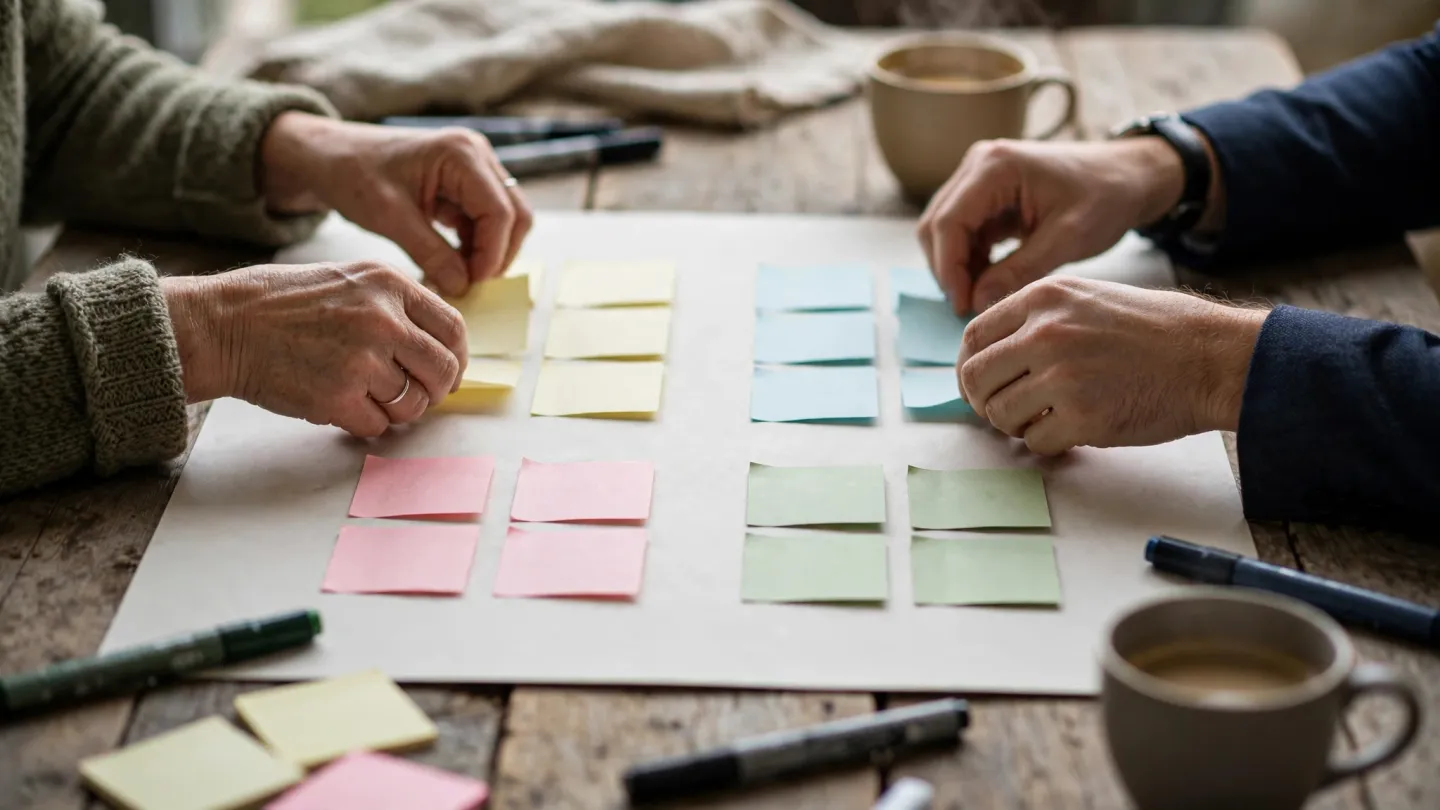
First what kind of problem, then who decides
The order matters more than it seems. If you start with the roles, you will assign roles inside the wrong process. If you start with the type of decision, half of the discussions about roles disappear on their own, because it becomes obvious who needs to be in the room.
Simple: there is a known good practice
Approving a leave request, choosing a supplier from an already negotiated list, any situation where the link between cause and effect is clear to anyone who looks at it. Here the right process is a written rule and one person who applies it. A meeting would only slow things down.
Complicated: there is a right answer, but it takes expertise
Choosing a technical architecture, the tax structure of a transaction, sizing a support team. There is an answer better than the others and it can be found, just not by just anyone.
The classic mistake here is democratisation. The room's opinion is asked for, a vote is taken, and the vote averages out one informed opinion and five intuitions. What you need is two or three experts who present their analysis, plus someone who decides between them.
Complex: the answer cannot be known beforehand
Entering a new market, changing the pricing model, reorganising a team that isn't working, almost anything that depends on how people behave. Here the link between cause and effect is only visible in retrospect. No analysis is good enough to replace trying.
The right process differs from the first two: several perspectives in the room, including the uncomfortable ones, two or three small experiments with a short deadline, and criteria written beforehand for what success would mean. Here, and only here, facilitation earns its money, because the value comes from the quality of collective thinking, not from speed.
Chaotic: a real crisis, the clock is running
A security incident in progress, an accident, a reputation crisis in the first hours. Here participation, however well meant, only delays the decision. One person decides, the rest execute, and the discussion of how we got here happens afterwards, necessarily, but afterwards.
The mistake here goes both ways. Some convene a committee in the middle of the fire. Others, more often, declare chaos for situations that are merely urgent, because crisis mode is comfortable: nobody challenges your decisions. An organisation that is permanently in crisis has, in effect, chosen to stop being contradicted.
The five roles missing from most meetings
Once you have named the type of decision, divide the roles. There are five, and the confusion between them produces more blockages than any disagreement on substance.
- Who recommends. The person who brings the proposal, with the options and the data. Usually exists. Usually doesn't have the time they would need.
- Who has to agree. The one without whose signature the decision can't pass: legal, finance, compliance. They hold a real veto and need to know they hold it, so that they use it early, not on the last day.
- Who implements. Those who will live with the result. If they enter the discussion only after the decision, you will learn the reasons it can't be done exactly when it is most expensive to learn them.
- Whose input is sought. Consultation without a veto. This is where the most frequent misunderstanding in organisations sits: people think that if they were asked, the decision partly belongs to them. If you don't say explicitly that it is consultation, you have promised a veto without meaning to.
- Who decides. One person. By name. Not a function, not a committee, not "management". The moment the room goes quiet at this question is the most useful moment of the meeting.
Being asked doesn't mean having a veto. If you don't say that out loud, you have promised exactly the opposite.
What it looks like in practice, in ten minutes
You don't need a workshop to use these things. You need ten minutes at the start of the discussion, every time, until it becomes a reflex.
- Name the type, out loud: simple, complicated, complex or chaotic. If there are two different opinions in the room about the type, that is the discussion you are having for the next few minutes, not the content.
- Name the decider. One person. Write the name where it can be seen.
- Name those who have to agree and those who are only consulted. Tell them the difference to their faces.
- Only now open the content.
The first time it takes more than ten minutes and it is uncomfortable, because it reveals that three people thought they had a veto. The second time it takes four minutes. By the fifth time someone else does it for you.
What changes when the team has this language
The most visible effect is not speed, although meetings get shorter. It is that disagreement moves to where it belongs: from implementation, where it is expensive and silent, into the discussion, where it is cheap and useful. A team that can say "I think we are treating as complicated something that is complex" has a way of contradicting each other without attacking, and that is worth more than any well-run meeting.
If you want to see the pattern on your own real decisions, the Decision Types Map kit has the A3 canvas to complete with your team, plus the guide for the leader and the one for the facilitator. And if the problem behind it is more about direction than about decision, strategic alignment is a different kind of intervention.
Get the Decision Types Map
An A3 canvas to print, a roles area to complete with your team and two short guides, for the leader and for the facilitator. Free, downloads instantly in your browser.
Download the kit