
How to choose a facilitator: ten questions to ask before you hire one
Most clients ask for a quote and compare prices. Price is the last thing that separates two facilitators, because no two of them are selling the same thing. The questions below reveal what you are actually buying, in a 30-minute conversation, before you sign anything.
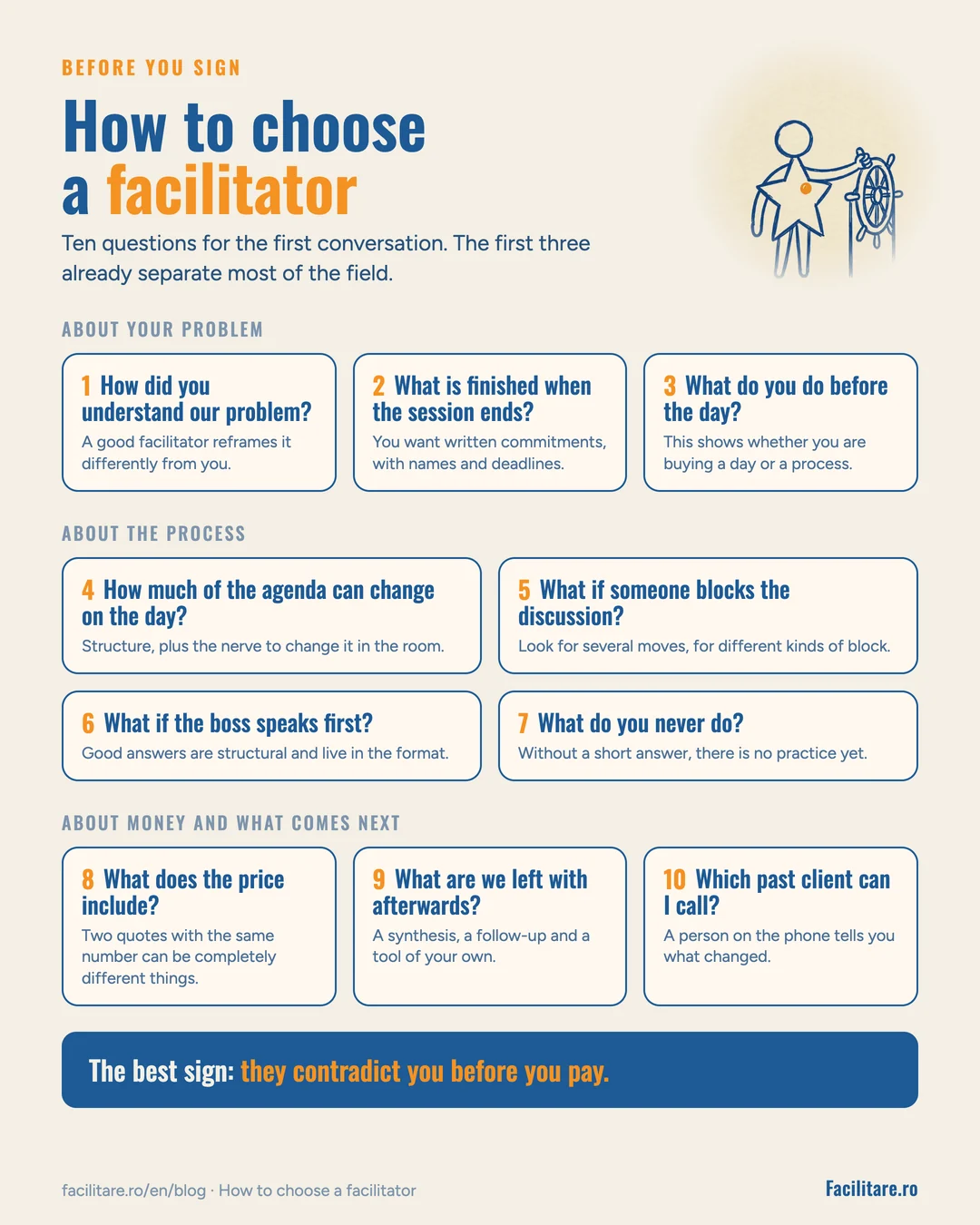
For each question: what it tests, what a reassuring answer sounds like, and what should give you pause. You do not need all ten. The first three already separate most of the field.

About your problem
1. How did you understand our problem, after I described it?
The first and the most useful. You are asking them to reformulate, not to sell. A good facilitator will phrase it differently from the way you did, and will name something you did not put on the table, because they have seen the pattern before.
2. What ends at the end of the session?
The question that separates a pleasant day from a useful one. You want to hear a verifiable outcome, not a state of mind.
3. What do you do before the day itself?
This is where you see whether you are buying a day or a process. The work beforehand is the least visible part and the most predictive of the outcome.
About the process
4. What does the agenda look like, and how much of it is negotiable during the day?
You are testing two things at once: whether they have a structure, and whether they are willing to abandon it. Both matter. A rigid agenda runs over whatever shows up in the room; no agenda lets the group circle.
5. What do you do if someone blocks the discussion?
You are not looking for one recipe, you are looking for whether they have several. An experienced facilitator has three or four different moves for three different kinds of blockage, and explains them simply.
6. What do you do if the boss speaks first and nobody contradicts them afterwards?
The most common real way a session gets wasted. You want to hear design solutions, not solutions that depend on courage.
7. What do you never do?
The question that extracts the most truth with the fewest words. Someone without an answer does not yet have a practice, they have a repertoire.
About money and about what comes next
8. What does the price include?
Do not ask what the day costs, ask what is in it. Two quotes with the same number can be two completely different things.
9. What happens after the session, and what are we left with?
You are testing whether they sell a day or a change. And, more importantly, whether they leave you more capable or more dependent.
10. Which of your previous clients can I call?
Do not ask for logos, ask for a phone number. Logos say someone entered the building once. A person who answers the phone tells you what changed afterwards.
The best sign that you are talking to a good facilitator: they contradict you before you give them any money.
Three questions they ask you, if they are any good
The evaluation runs both ways. If you hear nothing from the register below in the first conversation, you are talking to a supplier, not to a process partner.
- "Who decided this session was needed, and what do they hope to get?" The gap between sponsor and participants is the most frequent source of a wasted session.
- "What has been tried so far, and why did it not work?" If the team has already been through two workshops with no follow-through, the third one starts with a handicap that someone needs to name out loud.
- "What decision is already made and not up for discussion?" It is not a problem that one exists. It is a problem if it goes unsaid, because participants sense it within the first hour and shut down.
What the proposal must say
After the first conversation you receive a proposal. You checked the price at question 8. Four more things need to be in writing, because they are the ones most often argued about after signing.
More than one scope option
Three options show you what changes as the budget goes up or down: how many people take part, how much preparation, whether there is a follow-up. With a single option you say yes or no without knowing what was left out.
Confidentiality, point by point
The confidentiality agreement is signed before the diagnosis, because even the conversation before a quote contains sensitive material. What the session produces (flipcharts, digital boards, photos) stays yours. On delicate topics it is agreed at the start what reaches the sponsor, and participants hear this in the first minutes.
What happens at scale
Above 60 participants you need a team: a lead who holds the thread of the whole session and small-group facilitators working in parallel. Above 150 people a technical rehearsal is added the day before, because at that scale a room with poor sound does more damage than any exercise. Someone who offers to run 120 people alone on a decision day will end up moderating, and the group will end up listening.
What they ask of you
A sponsor with authority over what changes after the workshop, available for two or three conversations: the diagnosis, the design review and the debrief. It can be anyone in leadership who can say "this direction applies". Projects that go badly usually have a sponsor who delegated everything and showed up at the end. A facilitator who asks nothing of this kind has not yet seen enough projects.
What matters less than you think
- Years of experience. Twenty years of delivering the same workshop are not twenty years of experience. Ask what they have changed in their practice in the last two years.
- The list of big-name clients. It says they sell well, not that they deliver well. A bank's logo on a slide tells you nothing about whether that bank's team decided anything.
- Certifications on their own. They are a useful filter and they show a practical assessment of process competence (the Certified Professional Facilitator credential is awarded to individuals, by the International Association of Facilitators, not to firms). But they say nothing about fit with your situation, and fit is the criterion that decides.
- A method with a proper noun. LEGO® Serious Play®, Design Thinking, Sociocracy, Open Space, all of them are good. The question is not which method they know, but why they would use it on yours.
Frequently asked questions
What should you ask a facilitator before hiring them?
Ten questions cover almost everything that matters: how you understood our problem, what ends at the end of the session, what you do before the day itself, what the agenda looks like and how much of it is negotiable, what you do if someone blocks the discussion, what you do if the boss speaks first and the group goes quiet, what you never do, what the price includes (how many preparation days, how many delivery days, what deliverable), what happens after the session and what we are left with as a team, and who we can call among your previous clients. Good answers are specific and contain some disagreement with you; the answers to avoid are lists of methods and promises of guaranteed outcomes.
What are the red flags when choosing a facilitator?
Four show up most often. First: they accept your brief without a single question that contradicts you, which means they will deliver what you asked for rather than what you need. Second: they sell a method before knowing the problem, and the agenda is the same regardless of client. Third: they promise a guaranteed outcome, even though the outcome is produced by the group, not by them. Fourth: they have nothing to say about what happens after the session, a sign they are selling a day rather than a change.
How is a facilitator's price calculated?
The day in the room is the visible part, but not the whole of it. A serious engagement includes preparation days (interviews with participants, process design, materials), the delivery day or days, sometimes a second facilitator for large groups, and the time afterwards (synthesis of decisions, the follow-up session). The right question is not what the day costs but what the price includes: how many preparation days, what you receive in writing afterwards, and whether the follow-up session is included or billed separately. A quote with a single number and no process behind it is hard to compare with anything.
Does a facilitator's certification matter?
It matters, but less than people think and in a different way. A certification (for example Certified Professional Facilitator, awarded by the International Association of Facilitators to individuals, not to firms) shows that someone has been assessed in practice on process competence, which is a useful filter. It says nothing about fit with your situation: a facilitator who is excellent on strategy can be the wrong choice for a team in open conflict. The right order of criteria is: how they understood your problem, what they have done in similar situations, how they behave when you disagree, and only then certifications.
What is the difference between a facilitator and a trainer?
A trainer brings the content, because the team lacks knowledge. A facilitator brings the process, because the expertise is already in the room and what is missing is the way people reach a shared answer. If you need someone else's answer, with accountability attached, you are looking for a consultant.
How many people can take part in a facilitated session?
From leadership teams of 6–15 people to groups of several hundred. Above 60 participants the work is done by a team of facilitators: a lead who holds the thread and small-group facilitators working in parallel. Above 150 people a technical rehearsal is added the day before.
Can a session be facilitated online or in English?
Yes, in person, online or hybrid, in Romanian or English. The condition is that the design is rebuilt for the format. A room agenda moved onto a video platform loses exactly the moments where the group does its work.
If you are still not sure you need facilitation rather than something else, what facilitation actually is is a more useful place to start than any supplier list. If a high-stakes workshop is already on your calendar, see how we select the facilitator and design the process for a company. For situations that call for mediation, moderation or consulting instead, see where facilitation ends.
Ask us these questions
The first conversation is a free 30-minute diagnosis, and it sometimes ends with "you do not need a workshop". When that is the case, we say so.
Book 30 minutes, no sales pitch