
LEGO® Serious Play® workshops in Romania
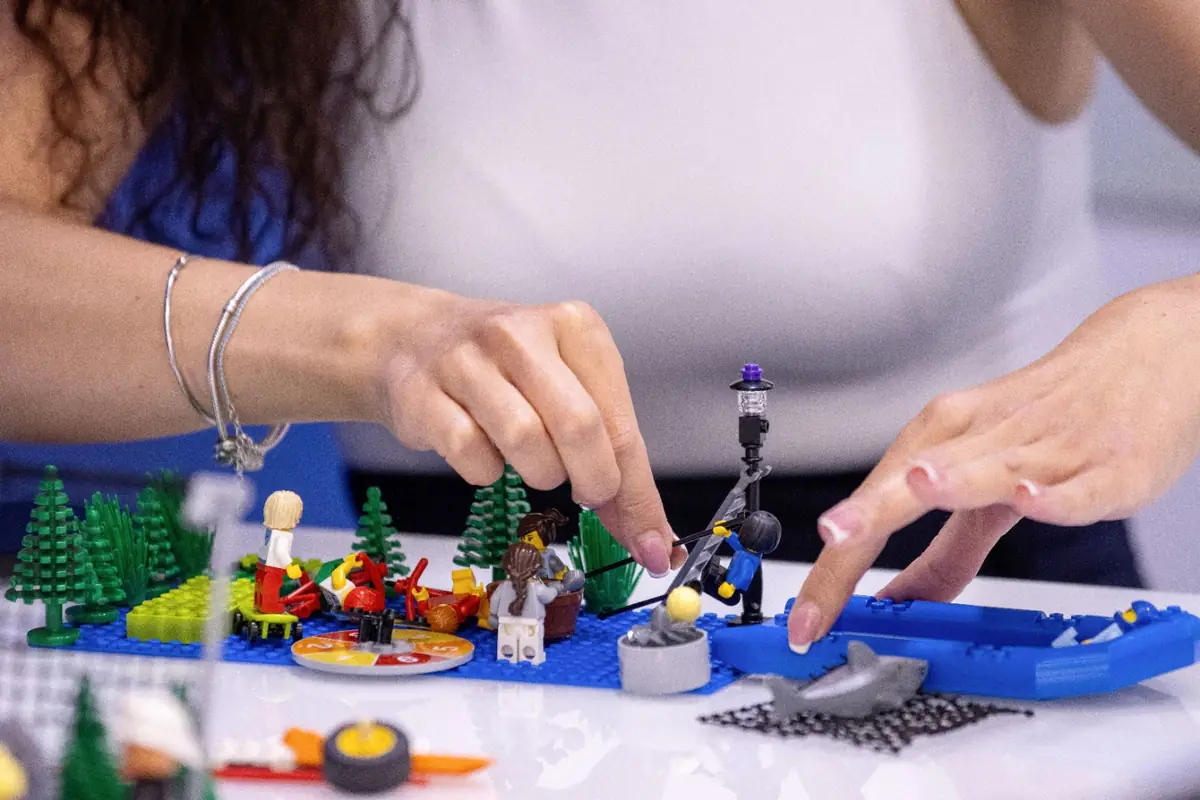
LEGO® Serious Play® is a facilitation methodology in which each participant builds a 3D model in answer to a serious question, then tells its story to the group. The hands think differently from the mouth: the model brings to the surface what presentations hide. The rule that changes everything is that everyone builds and everyone tells their story, so the whole group contributes, not only the three people who usually speak.
When it is worth it and when it isn't
It is worth it when the subject is abstract or charged: vision, values, the identity of a team or a product, relations between departments, a tension everyone feels and nobody puts into words. It is also worth it when strong voices dominate the conversation: the method's protocol neutralises them without accusing anyone.
It isn't worth it when the decision is simple and urgent, when the decision has already been made and you want a formal validation, or when the team lacks basic technical knowledge on the subject. You don't need bricks to choose a launch date.
What a session looks like, step by step
- The skills warm-up. Two short builds, with nothing at stake, so everyone gets past "I'm no good at LEGO". It is all about letting the hand work before the explanation; skill matters very little.
- The question. A single question, formulated together with you before the session. Everything else in the day depends on it: "what does our team look like in two years" gives different material from "what is in our way right now".
- Individual building. Everyone builds alone, in limited time. Nobody comments, nobody looks over a shoulder.
- The story of the model. Each person presents their model. The group questions the model, not the person: "what does this red piece here mean?", not "why do you think that?". The difference seems small and completely changes the temperature of the conversation.
- The shared model. The individual models are aggregated into a group model, where the real negotiations appear: what goes in, what goes out, what sits next to what.
- Translation into text. What was built becomes working principles, decisions or an identity formulated in the team's own words. Without this step you are left with nice photos and nothing for Monday morning.
What you get at the end
- The summary document
- Photographs of the models, the story of each one and the conclusions, written in the team's language, not in facilitator jargon.
- The decisions or principles
- What was built, translated into wording the team can use in meetings: working rules, priorities, decision criteria.
- A shared language
- The part nobody promises and that shows up most often at 30 days: people keep referring to the models built, as a shortcut for conversations that used to take an hour.
The practical format
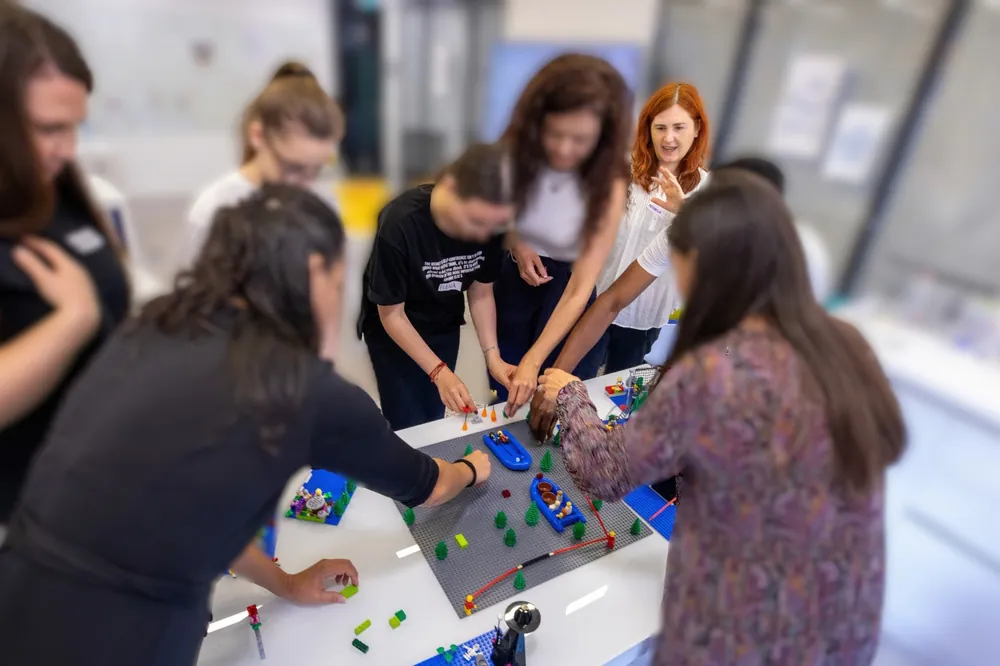
From half a day (one question, one level of building) to two days for team strategy with several rounds. The optimal group is 8 to 12 people per facilitator, because each person tells the story of their model; above 12 we work on parallel tables, with additional facilitators. Below 6 people the method loses value, because the diversity of models that makes the conversation interesting disappears. Sessions are held in Romanian or in English, at your office or in a space chosen together. We bring the pieces.
Who delivers it
In our team, LEGO® Serious Play® is the practice of Mihaela Danciu, a facilitator certified in the method and, for many years now, local organiser and partner of Trivium trainings in Romania. She trained in 2016, in Bucharest, with Jens Rottbøll, trainer and Trivium partner, through the Trivium International / Association of Master Trainers line: one of the lines with direct roots in the development of the method. She uses it for team strategy, identity and alignment between departments. See the full profile and the rest of the team.
As with every request, we start with a 30-minute diagnosis: often the conclusion is that you need a different method, and we say so before the quote, not after.
Not sure this method is the answer?
LEGO® Serious Play® is one of the methodologies we use, not an end in itself. If your blockage is a different one, it probably has a different remedy: meetings that never reach decisions, plans that contradict each other between departments, tensions nobody says out loud. The full catalogue, with what we use and when: our facilitators' methodologies.
Frequently asked questions
The method is delivered by facilitators trained in it, not by suppliers of bricks. In the Facilitare.ro team, LEGO® Serious Play® is the practice of Mihaela Danciu, a certified facilitator, trained in 2016 in Bucharest with Jens Rottbøll (trainer and Trivium partner), through the Trivium International / Association of Master Trainers line, and the local organiser of Trivium trainings in Romania. Sessions can be held in Romanian or in English, in Bucharest or at the client's location.
A teambuilding with LEGO aims at a shared experience: you build something together and feel good. LEGO® Serious Play® is a facilitation methodology with a strict protocol: a serious question, individual building, then each person tells the story of their model, and the group questions the model, not the person. What comes out of the room is a decision, a map of relationships or an identity formulated in the words of the people in the room.
When the decision is simple and urgent: you don't need bricks to choose a launch date. When the decision has already been made and you are looking for validation. And when the team lacks basic technical knowledge on the subject: there you need training first. The method is expensive in time, so it is worth it only when the subject is abstract or charged: vision, values, identity, tensions between departments.
From half a day to two days for team strategy with several rounds. The optimal group is 8 to 12 people per facilitator, because each participant tells the story of their model; above 12 we work on parallel tables, with additional facilitators. Below 6 people the method loses value.
The models are photographed and documented with each one's story, and the conclusions leave the room as text: working principles, an identity formulated in the team's own words, a map of relationships or the list of decisions taken on. The bricks stay with us. What stays with the team is the summary document and a surprisingly durable shared language.
Have a question worth building?
A free 30-minute diagnosis tells both of us whether LEGO® Serious Play® is the right method or just the most spectacular one.
Let's talk about your sessionLEGO®, SERIOUS PLAY®, the LEGO logo and the minifigure are registered trademarks of the LEGO Group, which does not sponsor or endorse this site. The LEGO® SERIOUS PLAY® methodology is made available by the LEGO Group under a Creative Commons licence (Attribution Share Alike 3.0).