
What a stranger sees in the first five minutes in your office
A candidate who comes for an interview forms an opinion about your culture in the first five minutes, before shaking anyone's hand. Not from the values on the wall. From the notice left in the hallway two years ago, from the tone of the note on the fridge, and from what happened to last Friday's flipchart.
You have seen these things a thousand times, so you no longer see them at all. That is both the problem and the opportunity: it is the only culture diagnostic that needs no budget, no survey and nobody's permission.
Why such a simple diagnostic works
Culture doesn't live in documents, it lives in traces. Every item posted, moved or left lying around in an office is the result of repeated behaviour, and repeated behaviour is the practical definition of culture. A survey gives you what people declare about themselves, with their name on the form. A five-minute walk gives you what they do when nobody asks them anything.
The advantage is that you can't falsify the traces retrospectively. The notice in the hallway has been there for two years. Nobody wrote it to send a message about culture, and that is exactly why it sends a very precise one.
Five stops, in the order a visitor sees them
1. The entrance
The first thing seen by someone who has never been here. It doesn't matter whether it is pretty, it matters whether someone in particular looks after it. An entrance that nobody claims looks the same whatever the company's budget.
Look at what is posted and since when. A poster from an event in 2024 says little about aesthetics and a lot about what ends and what never ends in your organisation.
2. The hall or reception
This is usually where the values wall is. The useful question is whether someone could guess them from the rest of the hall alone. How nicely they are written matters very little. If the values on the wall and the objects around them say different things, people believe the objects.
3. The coffee area
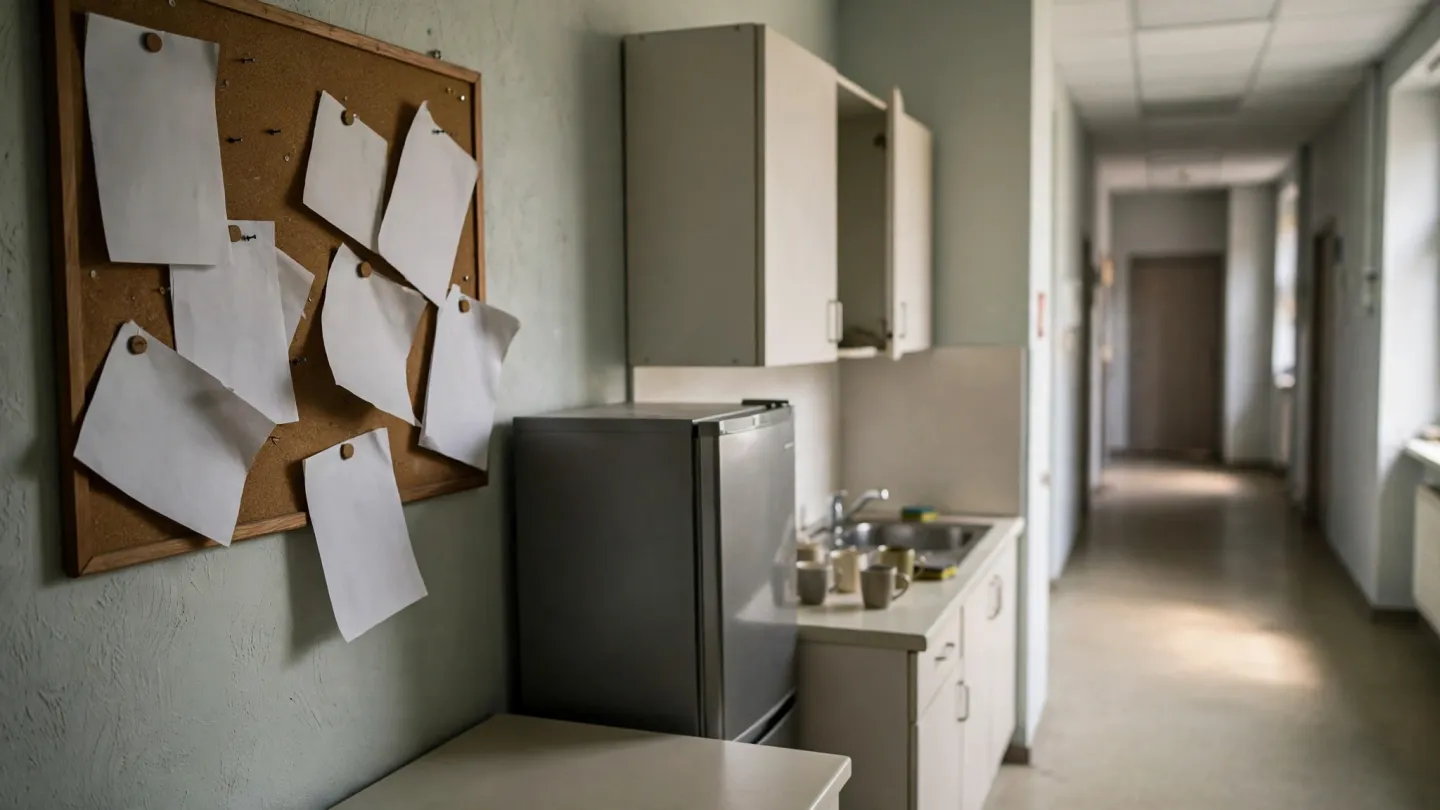
The richest point of all five. This is where the notes appear, and notes have tone. A notice saying "please wash your cup after you" and a notice saying "STOP LEAVING DISHES IN THE SINK!!!" describe two different organisations, in which something different happened before.
Ask yourself what each notice assumes about colleagues: good faith or bad faith. A space full of rules written in capital letters is a space where someone has given up discussing things with someone else.
4. The bathroom
The stop everyone winces at, and the most honest on the list. It is the only space no client sees and, for that very reason, the only one not maintained for show. The difference between how the boardroom looks and how the employees' bathroom looks is the cheapest indicator of real hierarchy you have available.
5. The meeting room
Look for traces of decisions, not for technology. Is there anything on the walls from what was worked on last week? Was the flipchart from the last session photographed and sent around, or wiped to make room? Is anything left in writing that someone will use on Monday?
A room where nothing survives from one meeting to the next is a room where meetings produce nothing worth keeping, and the team learned that long ago.
The rule that makes the method work
You note what you see, not what you know. If you start explaining, cut the explanation: the explanation is exactly what the stranger doesn't have.
It is the only rule and it is hard to keep, because you have context for absolutely everything. You know why the poster is there, who was supposed to take it down, what happened in that period and why it isn't anyone's fault. A candidate knows none of that. They see an old poster and draw a conclusion in two seconds.
In practice: every time you hear yourself saying "yes, but that's because", stop and write down the observation without the justification. The justifications you cut are the list of things the organisation has got used to.
What to do with what you found
Three mistakes make any diagnostic of this kind useless, and the first is the most frequent.
- Don't present it as a verdict. You observed alone, subjectively, in five minutes. If you walk into the meeting with conclusions about culture, you get defensiveness. If you walk in with observations and a question, you get discussion.
- Don't fix everything. Pick the stop with the lowest score and one visible thing to change this month. A notice rewritten in a different tone changes more than a workshop about values, because people believe what they see daily, not what they are told once.
- Don't confuse the symptom with the disease. The dishes in the sink aren't about dishes. They are about what happens at your place when someone has a problem with a colleague: is it discussed, or is a capital-letter notice written for everyone? The answer to that question is the culture, the rest are traces.
Who it helps
Team leaders who feel something isn't working but have neither evidence nor a diagnostic budget. HR people who need something concrete before a conversation about culture, so they don't open with generalities. And facilitators, as a ritual before a session: ten minutes of walking through the space, before the first question put to anyone, changes how you listen for the rest of the day.
If you want to go further than traces, toward what people feel and what they allow themselves to show, that is where emotional culture begins: the part of culture that is written nowhere and that no set of posted values can fix.
Get the "What a stranger sees in 5 minutes" pilot
The five stops, with the concrete list of things to look at in each one, a score out of 25 and four thresholds to read on your own. A PDF plus an interactive version that stays entirely in your browser.
Download the pilot