
Where a good training goes after two weeks
A client told me, about a month after a teambuilding that had gone very well: "For about two weeks the team was different. Then we went back to where we started." He wasn't complaining. He was stating a fact.
I have heard that sentence, in other words, after feedback trainings, sales trainings and leadership trainings. The day goes well, the evaluations are high, people leave with energy, and after about two weeks everything is back to how it was. Almost every time, the day itself had been good.
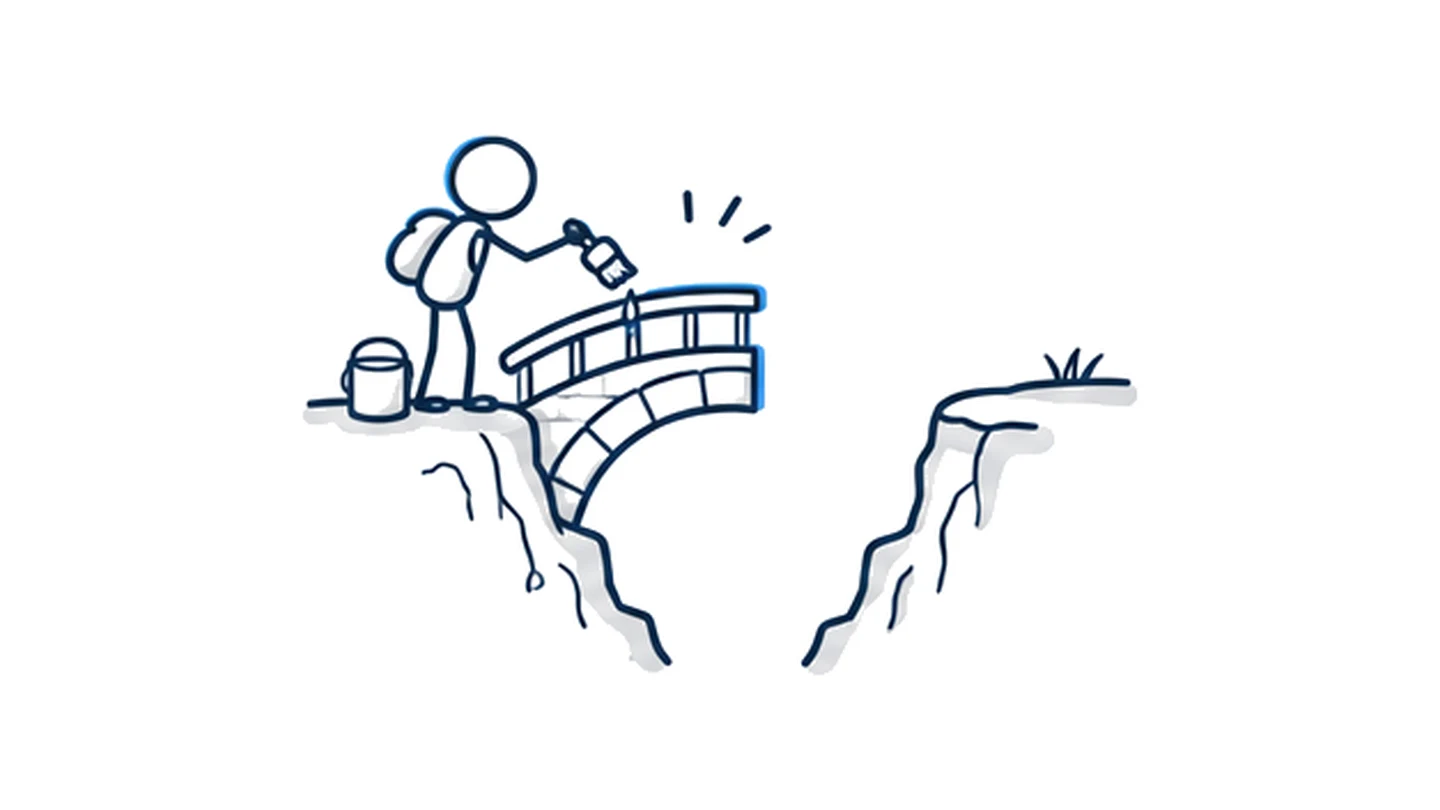
The question asked wrongly
After a training that left no trace, almost everyone goes back to the same question: what didn't work at the course? The trainer is changed, the slides are rewritten, a module is added. In other words, the part that was already working gets repaired, with money.
The useful question looks elsewhere. What happened in the first two weeks after people got back to the office? Who asked them anything? Where did they have the chance to use what they practised? Who noticed when they tried?
Research on training transfer has been saying this for more than twenty years. Elwood Holton, Reid Bates and Wendy Ruona published in 2000 an instrument that measures what in the work environment helps or blocks the application of a course, tested on 1,616 participants. The exact number of factors has varied from one study to another. The underlying idea has stayed the same: application depends on the system around the person at least as much as it depends on the person.
Three things that happen, or don't, after the course
Of all the factors studied, three can be seen with the naked eye, without any questionnaire.
The boss asks
It has the biggest effect and the lowest cost. The boss doesn't have to know the content of the course or even have been there. They have to ask one question at the right moment. People read priorities from what the boss asks about more than from what the strategy says. If every morning the question is about the numbers and never about the course, the team draws its own conclusion: the course was a break from work.

There is one more gesture that costs nothing. The first attempt at a new behaviour almost always turns out worse than the old habit, which has years of practice behind it. If the first clumsy attempt is treated as a mistake, the second one won't come.
Colleagues talk
A new behaviour also carries a social risk. If you try it alone, in front of colleagues who weren't at the course, you look odd. If three of you try it at the same time, it becomes "what we do now". It matters a lot whether the team went to the course together or in pieces, and whether those who weren't there know what was worked on. Sometimes it is enough for each person to have one person with whom to say, over a coffee, what they tried and how it went.

The opportunity exists
You can have a boss who asks and colleagues who talk and still lose, if the person has nowhere to use what they learned. The opportunity is prepared before the course. If you send the team to a feedback training, look in the calendar for when the next round of one-to-one conversations is. If it is in four months, you have a calendar problem that no trainer can solve. If it is in two weeks, you have the opportunity ready-made.
Expensive programmes most often fall where nobody looks: in the first two weeks after.
What real transfer looks like
This summer, at an IAF Romania meetup with 65 people, I worked with Method 35: unsigned tickets, passed around the room and scored in pairs, five rounds. At the moment of the vote nobody knew who had written what, not even me. Alex read out loud the ticket with the highest score and added: "I learned this in a session with Bogdan."
Two of the top tickets were methods worked on in sessions I had run years earlier: the emotional retrospective of the week and a safety check-in at the start of a meeting. I only found out when I asked the authors to give thirty seconds of context, and Alex and Laura stood up to say where they had got them from and why they use them.
It moved me more than any feedback form. I have worked in L&D for 20 years and we still measure the impact of a course three days after it, with an evaluation sheet. Real proof looks different: someone is using your method two years later, in a room where you taught nothing.
I also came away with an observation about what passes this test. What travels further are the methods simple enough to be told in two sentences and that produced something real in the session where you first tried them. If a participant can't reconstruct the exercise from memory on Monday morning, the exercise stays in the room where they learned it.
What to change at the next training
- Before you sign the proposal, set how you will know, at 30 days, that something has changed. If you don't do it now, at 30 days nobody asks any more.
- Send people together, or at least two or three from the same team. One person who comes back alone with new ideas runs into everyone else.
- Put a 45-minute meeting in the calendar two to three weeks after the course, with a single question: what did you try, what got stuck, what will you change. The format is called a transfer session and it is the cheapest thing you can add to a training.
- Tell the boss exactly what to ask in the first week. One sentence, in writing, sent by L&D the day after the course.
Where it gets lost at your place
So that it doesn't all remain at the level of intuition, we built a short instrument, What remains from training. You answer fifteen statements about the last training in your team, in about four minutes, and see on five dimensions which of the after-course conditions is missing. At the end you can request a plan for the next 30 days by email. The answers stay in your browser.
And if you want the whole mechanism, from the debrief to the formats after the course, I wrote it in a free guide that carries in its title the client's sentence from the start: "For about two weeks the team was different".
See where your last training got lost
What remains from training: 15 statements, four minutes, free. You find out which of the five after-course conditions is missing in your team and where to start in the next 30 days.
Complete the instrument