
The debrief: twenty minutes you will never cut from the agenda again
For years I filled every silence in the room. I talked over participants, reworded the same idea, threw in another example "to make it clear", answered my own question. It took me a while to understand that I wasn't helping anyone.
That reflex costs the most in one particular place: the debrief, the minutes after an exercise in which an experience becomes something people can apply on Monday.
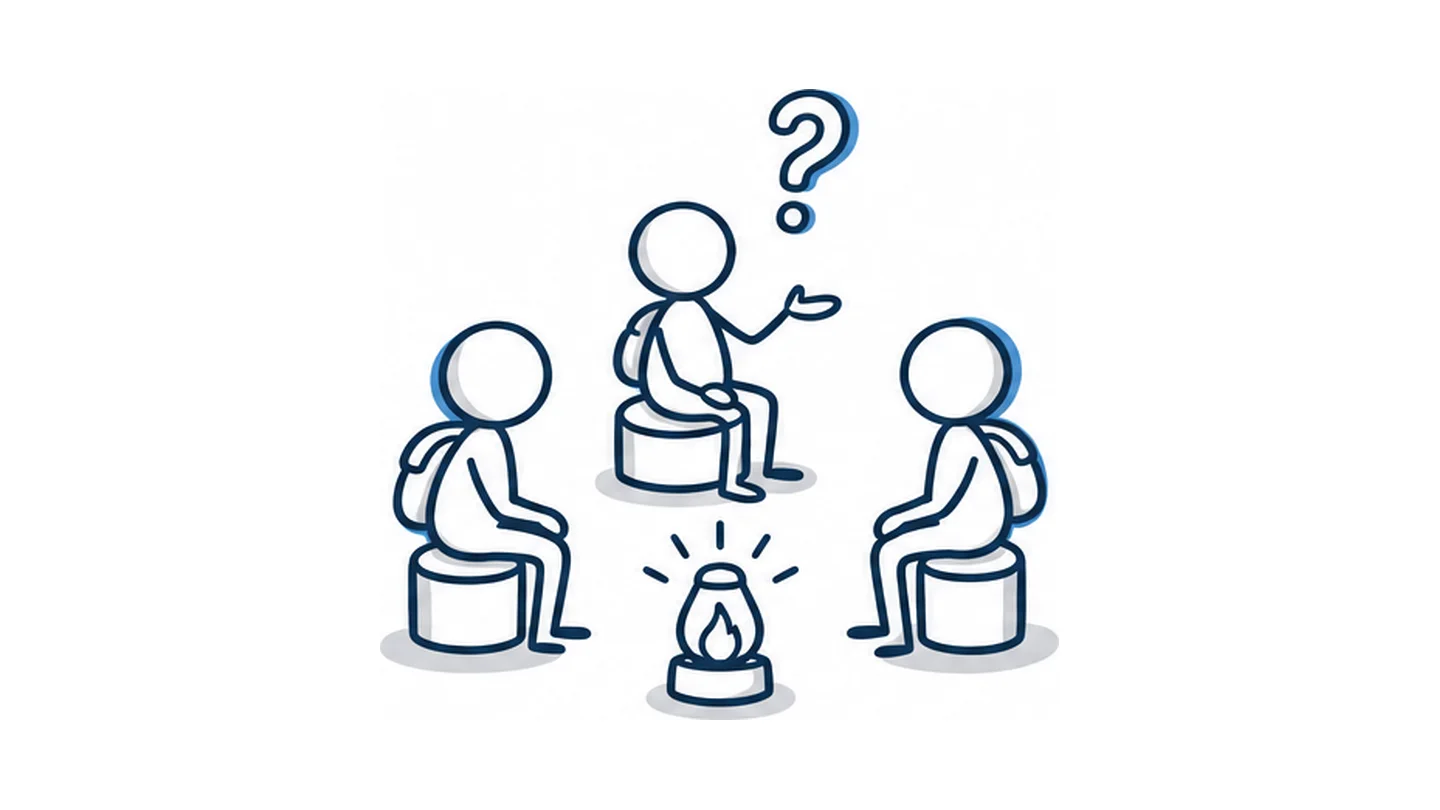
Why it gets cut first
Almost every training day runs late at some point. An activity takes longer, a discussion drifts, a break stretches. Someone looks at the agenda, sees the debrief at the end and shortens it. Sometimes they cut it entirely, so people can catch their train. It seems like common sense: the exercise was done, the idea was understood.
Without those minutes, the exercise remains a pleasant memory, sometimes a good story to tell over a beer, with no bridge to Monday's work. Nobody leaves the room with a clear sentence about what they will do differently.
Three questions, that's all
There are more elaborate models: Borton, Kolb, Gibbs, Greenaway's four Fs, Thiagi's six phases. All of them can be reduced to three questions, asked in this order.
- What happened? Facts, without interpretation. Who spoke first, which question changed direction, at what moment the silence fell. If you let the group jump straight to "it went well", you get vague answers with nothing concrete underneath.
- What does it mean for us? The link between what was seen in the exercise and the patterns in real work. The participants make it. Your job is to leave enough time for them to find it.
- What do we do on Monday? No "what we could do" and no "it would be good to". What we do, who does it, by when.
The simplicity is deliberate. With a tired room and a late agenda, you can ask three questions properly. A six-stage model you will half skip.
Where the wish to sound clever betrays you
At the second question the biggest temptation appears: to name the pattern yourself, with a well-built sentence that sounds like a conclusion. The moment you say it, you have done the work you meant to leave to the group. An interpretation spoken by you, however correct, weighs less than one found by them, even if theirs is clumsier.

There is also a subtler version, which experienced facilitators do too: "Don't you think this actually shows a communication problem?" Technically, you asked a question. In practice, you gave the answer, and the group confirms it as docilely as a statement.
My weakest moments in the room were exactly the ones where I was trying to impress.
What to do with silence
The silence after a debrief question feels in the body like a public failure. For the group, it is the seconds in which it is thinking. Four small habits have helped me break the reflex of filling it:
- After a question, I count two or three seconds in my head before I look to see whether anyone wants to speak.
- When I need time myself, I say out loud "I'm taking ten seconds to think". The group then gets the same permission.
- After an important idea from someone in the room, I stay quiet instead of completing it with my own remark.
- I put reflection time in the agenda, in every block of the day, so I don't have to steal it from the end.
Four ways a debrief goes wrong
In the guide I gathered eight. Four appear most often:
They rarely come alone. The fear of silence almost always leads to the mini-lecture. If you recognise one of them in yourself, work on it for two weeks, then move on to the next.
If you are the one buying the training
Ask the provider three questions before you sign. How many minutes are protected for the debrief, and where exactly in the structure of the day? "If there's time left" isn't an answer. What kind of questions will be asked at the end: open ones, or ones that only ask for confirmation? And who writes "what we do on Monday", the group or the trainer? If the answer to the last one is a summary slide made by the trainer, the twenty minutes were just another presentation.
Monday's experiment
You don't need a spectacular exercise to practise. At the first team meeting after a project, put the three questions, in the order above, as the first three items on the agenda. Without the title "debrief" on the slide. Write down the answers to the first question without commenting on them and see what changes at the second.
The whole chapter on debriefing, free
The three questions, all eight ways of getting it wrong and the pairs in which they appear, plus what to ask a training provider, are in "For about two weeks the team was different", our free guide on learning facilitation.
Download the guide